Homocysteine is an amino acid your body makes itself while breaking down methionine. That is a protein building block from your food. In most people the value sits below 15 µmol/l. If it sits higher, that has been linked to cardiovascular disease.
It sounds like a simple story. And that is exactly where it goes wrong. The logical next step is lowering that value to lower your risk. That has been tested in large trials, and it disappointed.
I find this the most underexposed point on the Dutch homocysteine internet. So I will start there.

What is homocysteine and what does it do?
Homocysteine is a sulphur-containing amino acid. It appears as an intermediate when your body breaks down methionine. Normally your body clears it again. Folate, vitamin B12 and vitamin B6 are needed for that.
If the clearing works less well, homocysteine builds up in your blood. The value then rises. Those B vitamins are not a side note. They are the engine of the breakdown.
A raised value therefore often says more about your vitamin B12 and folate than about your vessels.
What does a raised homocysteine level mean?
A raised homocysteine level usually means the breakdown is stalling. The most common reason is a shortage of folate, B12 or B6. Your kidneys, smoking, heavy alcohol use and some medicines push the value up too. A hereditary variant in the MTHFR gene sometimes plays a part.
A high value is therefore a clue, not a diagnosis.
| What you see | What often sits behind it | What you can look at alongside |
|---|---|---|
| Homocysteine high, B12 low | A B12 shortage slowing the breakdown | Vitamin B12 |
| Homocysteine high, folate low | Too little folate from food | Folate |
| Homocysteine high, B vitamins normal | Sometimes kidney function, lifestyle or genetics | Discuss with your GP |
| Homocysteine normal | The breakdown route is doing its job | No further action needed |
Which homocysteine value is normal?
There is no single national figure. Laboratories use their own limits, and those differ. The Dutch Association for Clinical Chemistry gives under 16.4 µmol/l for men. For women it gives under 13.4 µmol/l.
Other sources use a single limit of 15 µmol/l. So read the reference value on your own result. Your laboratory's range is the one that counts.

Does homocysteine raise your cardiovascular risk?
It relates to it, but it probably does not drive it. A meta-analysis by the Homocysteine Studies Collaboration found a clear association (PMID 12387654). Higher values went together with more heart disease and stroke. Such an association says nothing about cause.
That difference is decisive here. The evidence came from the trials.
The HOPE-2 study gave over 5,000 people folic acid with B6 and B12. The homocysteine value dropped, but the number of heart attacks and deaths did not (PMID 16531613). A meta-analysis across 8 trials with 37,485 participants saw the same (PMID 20937919). A Cochrane review from 2017 reached the same conclusion (PMID 28816346).
Imagine your value falls from 18 to 9 µmol/l after three months of B vitamins. On paper that looks fantastic. Based on those trials your cardiac risk probably did not fall with it.
Homocysteine behaves here like a smoke alarm. It goes off at a fire it did not start.
So why is it still on so many test panels?
Because as a signal it remains useful. A raised homocysteine level often points to a shortage of B12 or folate. That shortage is worth knowing about in itself. The value also adds context to a wider risk picture.
What it is not: a target you drive down at all costs.
My position will not please everyone. Have this value drawn without your B12 and folate beside it, and the number gives you little. It is a signpost. Then you also want to see where it points.
For the wider context: read our explainer on ApoB, hs-CRP and homocysteine. Also useful is our piece on vitamin B12 deficiency. How homocysteine fits the vascular story sits in our pillar on narrowed blood vessels.
How do you have homocysteine measured?
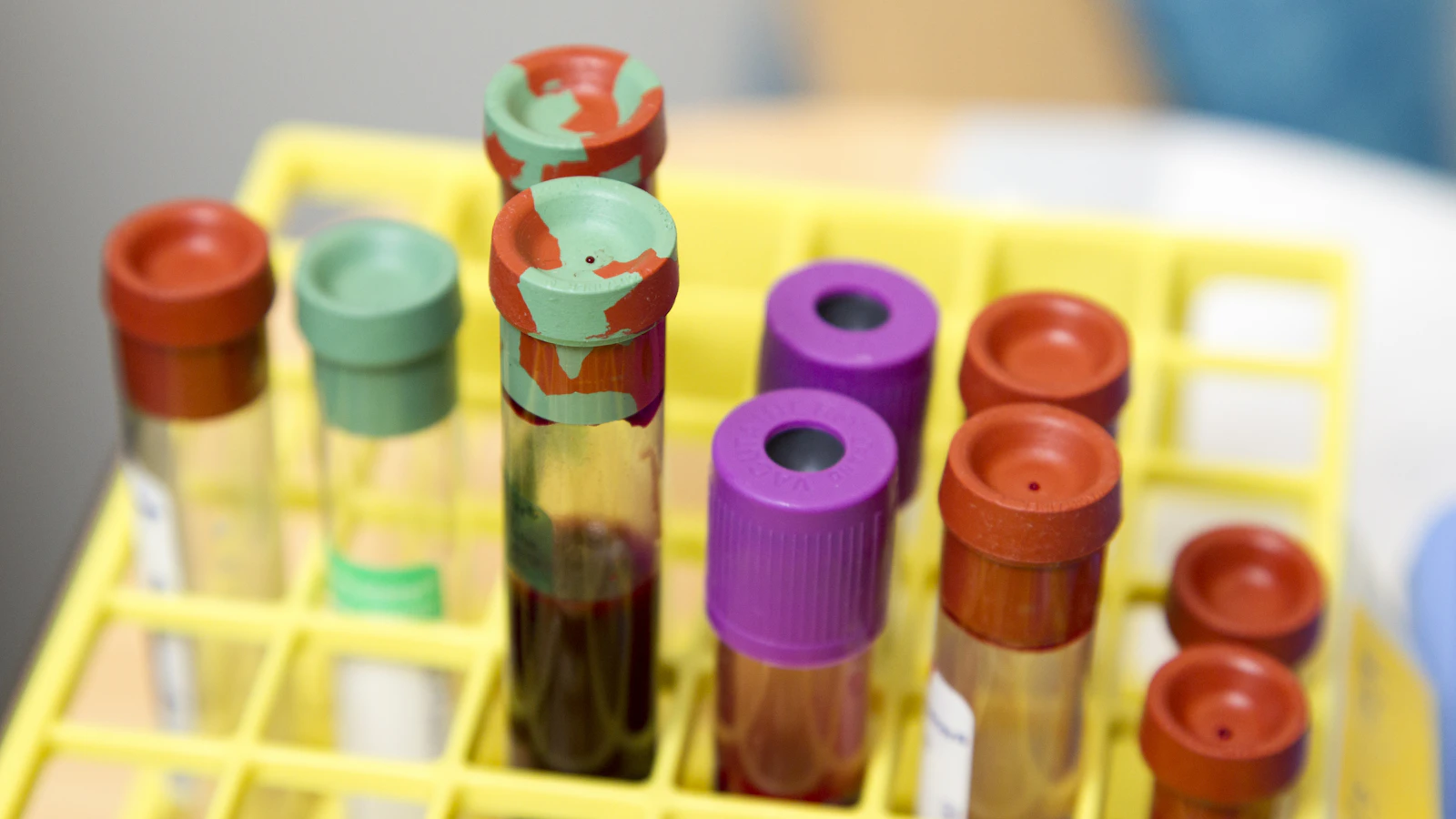
With an ordinary blood draw. You are usually fasting, because a protein-rich meal lifts the value for a while. The tube needs processing quickly. The value rises if blood stands too long.
With a high result, checking your B vitamins is the obvious step. See the homocysteine marker page for the details.
Frequently asked questions
Is homocysteine the same as cholesterol?
No. Cholesterol is a fat that builds up in the vessel wall. It relates causally to vascular disease. Homocysteine comes from your protein metabolism and behaves mainly as a signal.
What is a normal homocysteine value?
That differs per laboratory. The NVKC gives under 16.4 µmol/l for men and 13.4 µmol/l for women. Other sources use 15 µmol/l. So read the reference value on your own result.
Should I take B vitamins with a high value?
That is a conversation with your GP, not with a blog. B vitamins lower the value reliably. In trials that did not prevent cardiovascular disease. With a proven shortage the trade-off looks different.
What I would leave you with
Treat this value as a question, not as a score. Do you get a result above the reference value back? Then ask your GP about your B12, your folate and your kidneys. Do that before anything gets swallowed.
Every blood test result at Vitalcheck includes a professional assessment from a BIG-registered doctor. Always discuss treatment decisions with your GP.
References
- Homocysteine Studies Collaboration. Homocysteine and risk of ischemic heart disease and stroke: a meta-analysis. JAMA. 2002. PMID 12387654
- Lonn E, et al. Homocysteine lowering with folic acid and B vitamins in vascular disease. New England Journal of Medicine. 2006. PMID 16531613
- Clarke R, et al. Effects of lowering homocysteine levels with B vitamins on cardiovascular disease, cancer, and cause-specific mortality. Archives of Internal Medicine. 2010. PMID 20937919
- Marti-Carvajal AJ, et al. Homocysteine-lowering interventions for preventing cardiovascular events. Cochrane Database of Systematic Reviews. 2017. PMID 28816346
- Dutch Association for Clinical Chemistry and Laboratory Medicine. Homocysteine. Allesovertesten.nl. Accessed 2026.
- RIVM. Cardiovascular disease: figures and context. Volksgezondheid en Zorg. Accessed 2026.
Autor
Vitalcheck
Dr. Naimi, lekarz wpisany do holenderskiego rejestru BIG, nadzoruje standardy medyczne naszych treści i ocen. Przeczytaj naszą politykę medyczną
Powiązane badania
Powiązane artykuły
Heart skipping a beat: what happens during an extrasystole

Pounding heart at rest: why you feel your heartbeat so strongly