
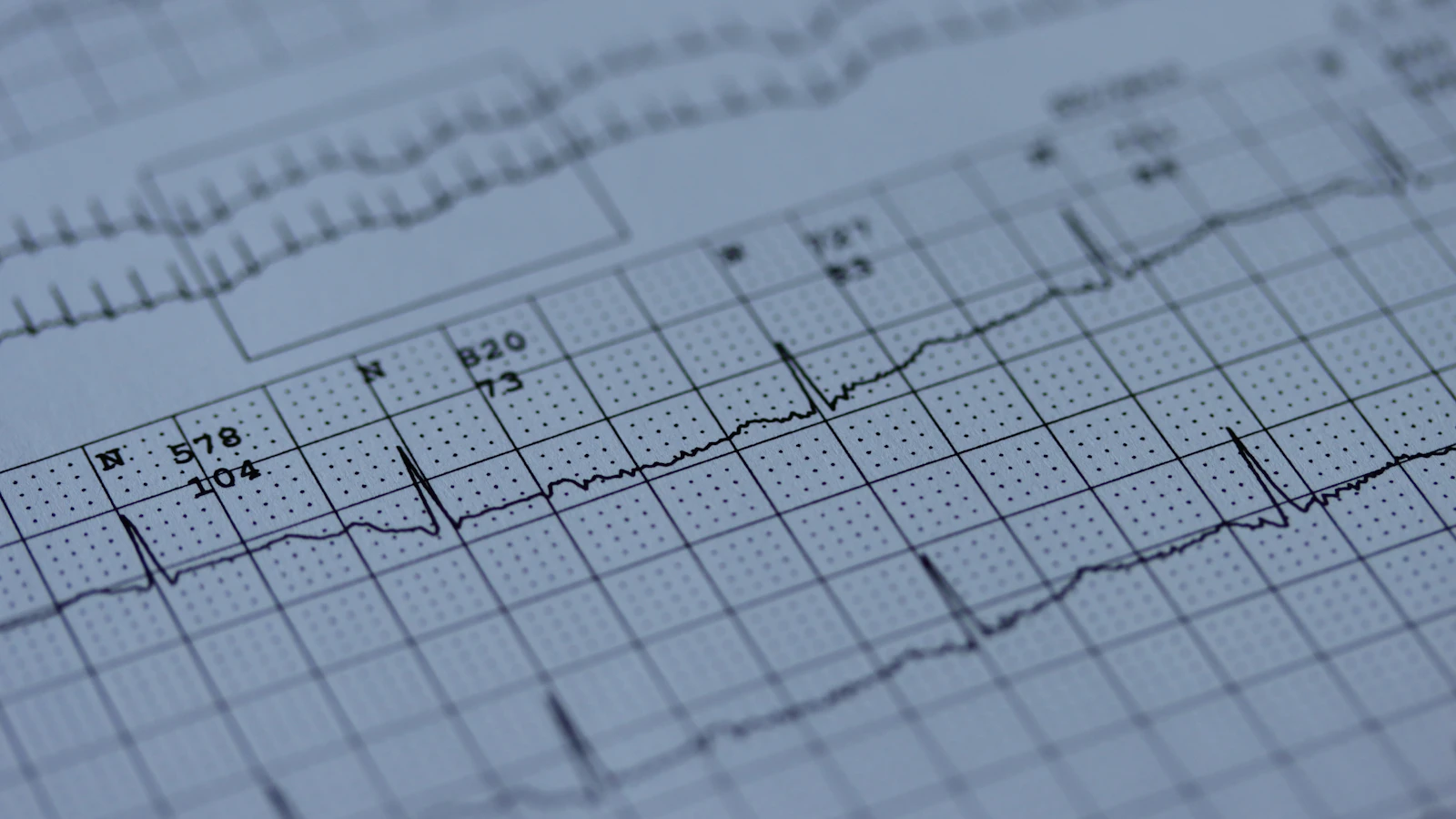
Your resting heart rate is probably the cheapest heart signal you have. No lab, no appointment, just two fingers on your neck or the sensor already on your wrist. And it is useful too: for every 10 beats per minute higher, the risk of dying sits around 9 percent higher on average (Zhang et al., PMID 26598376).
That sounds more alarming than I mean it. A high resting heart rate is rarely a heart problem. It is usually a story about sleep, stress, caffeine, fitness or something playing out elsewhere in your body.

What is a normal resting heart rate?
In adults the resting heart rate usually sits between 60 and 100 beats per minute. That is a wide range, and where you sit within it depends on your fitness, your age, your medication and your sleep. Trained endurance athletes sometimes sit below 50 without anything being wrong. The Hartstichting uses the same range.
Measure it properly: seated, after a few minutes of rest, and not just after coffee, exercise or a stressful conversation. A single measurement says little, a line across weeks says more.
What does a high resting heart rate mean?
Usually that your body is working harder at something. Sleep loss, stress, dehydration, alcohol, caffeine, fever and low fitness all push your resting heart rate up. An overactive thyroid, anaemia and some medicines can lift it too. If it stays above 100 without a clear reason, that belongs with your GP.
| Resting heart rate | What it often means | What you can look at alongside |
|---|---|---|
| Below 60 | Often good fitness, sometimes medication | Usually nothing, unless you feel dizzy |
| 60 to 80 | Common for most adults | No action needed |
| 80 to 100 | Within range, but the higher side | Sleep, stress, caffeine, fitness |
| Above 100 at rest | Tachycardia, should be assessed | TSH, haemoglobin, your GP |
| Irregular, at any range | Rhythm weighs more than speed | Always your GP |
Is a high resting heart rate a risk factor by itself?
The research does point that way. In the Copenhagen Male Study almost 2,800 healthy men were followed for 16 years: per 10 beats per minute higher, the risk of dying sat around 16 percent higher, even after adjusting for fitness and exercise (Jensen et al., PMID 23595657). That last part is the crux.
Because the easy explanation is that a high resting heart rate simply measures poor fitness. This study adjusted for that and the association held. In healthy men and women too, an elevated resting heart rate proved independently associated with cardiovascular disease (Cooney et al., PMID 20362720).
Say you take two men of 45, both non-smokers, both with an LDL of 3.0 mmol/l. One has a resting heart rate of 58, the other 84. Statistically that is not a draw. What I take from it myself: this is a signal you get for free and that gets ignored too often.
Which blood values add context here?
A blood test does not measure your heart rate, but it can make visible a few causes that lift it. An overactive thyroid speeds up your metabolism and with it your heart rate. Anaemia makes your heart work harder to pump enough oxygen around. Those are two very different stories behind the same number.
- TSH: with an overactive thyroid, see TSH
- Haemoglobin and ferritin: with anaemia, see anaemia
- hs-CRP: with low grade inflammation, see hs-CRP
A basic health checkup covers part of those questions in one draw. How your resting heart rate fits the wider vascular story sits in our pillar on narrowed blood vessels. See also what exercise does to your values in exercise and your blood values.
Can you lower your resting heart rate?
In many people yes, and it takes less long than expected. Regular endurance training is associated with a lower resting heart rate, often within a few weeks. Sleeping better, less alcohol and less caffeine late in the day help as well. How much it does for you varies.
My advice there stays what it always is: measure a line, not a moment. One morning of 88 says nothing, three weeks around 88 when you normally sit at 65 is worth a conversation.
Frequently asked questions
Is a resting heart rate of 90 dangerous?
It falls within the usual range of 60 to 100, so by itself it is not an alarm. It does sit on the high side, and then sleep, stress and caffeine are the first things to look at.
Does my smartwatch measure my resting heart rate reliably?
For following a trend it is usually fine. For judging an irregular rhythm it is not: that needs a doctor.
What I would leave you with
Note your resting heart rate every morning for two weeks before you get up. If it stays above 100 without a clear reason, or feels irregular, make an appointment with your GP and bring your measurements. Every blood test result at Vitalcheck includes a professional assessment from a BIG-registered doctor. Always discuss treatment decisions with your GP.
References
- Zhang D, Shen X, Qi X. Resting heart rate and all-cause and cardiovascular mortality in the general population: a meta-analysis. CMAJ. 2016. PMID 26598376
- Jensen MT, et al. Elevated resting heart rate, physical fitness and all-cause mortality: a 16-year follow-up in the Copenhagen Male Study. Heart. 2013. PMID 23595657
- Cooney MT, et al. Elevated resting heart rate is an independent risk factor for cardiovascular disease in healthy men and women. American Heart Journal. 2010. PMID 20362720
- Hartstichting. Hoge hartslag. Accessed 2026.
الكاتب
Vitalcheck
Dr. Naimi، طبيب مسجل في سجل BIG الهولندي، يشرف على المعايير الطبية لمحتوانا وتقييماتنا. اقرأ سياستنا الطبية
فحوصات ذات صلة
مقالات ذات صلة
Heart skipping a beat: what happens during an extrasystole
Pounding heart at rest: why you feel your heartbeat so strongly