
Your calendar age is on your passport. Your biological age, how old your body is functionally, can differ from it by five to ten years. Two people of 45 can have blood values that belong to completely different decades. That's the most interesting insight from ageing research, to me: your age in years and the state of your body are not the same thing.
This piece explains what biological age is, how it differs from your calendar age, and which blood values can say something about it. No promises about staying forever young, just an honest look at what's measurable and what isn't.
What is biological age?
Biological age is an estimate of how old your body functions, based on measurable features such as blood values, rather than the number of years since your birth. The idea: ageing runs at a different pace in everyone, and that pace leaves traces you can partly measure.
Researchers describe ageing as a sum of processes. A widely cited review in Cell groups them as the "hallmarks of aging" (López-Otín et al., Cell, 2013). Think DNA damage, telomeres shortening (the protective caps on your chromosomes) and cells slipping into a kind of standby mode.
Those processes don't run neatly in step with the calendar. In one person they go faster, in another slower, and they even differ between tissues within your own body.
You don't see them in the mirror either. Wrinkles and grey hair say something about your skin and hair follicles, but little about your vessels, your kidneys or your metabolism. That's exactly where biological age tries to look.
One thing to hold on to: biological age is an estimate, not a diagnosis. Different methods give different numbers, and none measures your "true" age down to the year.
Biological age versus chronological age
Chronological age is simple: the number of years you've lived. Biological age tries to capture something else, namely how well your body functions right now. The gap between the two is exactly what people mean when they say someone "looks young for their age", but made measurable.
An example makes it concrete. Say two colleagues are both 50. One exercises three times a week, sleeps well and has tidy blood values. The other smokes, sleeps badly and has raised blood sugar. On paper they're the same age. Their bodies tell a different story.
That difference isn't set in stone. Someone can have an unfavourable pattern at 40 and a more favourable one at 45, or the other way round. That's exactly why many people find the idea appealing: it feels less like a fixed fate and more like something you can keep an eye on.
Why is that useful? Because processes like high blood sugar or quiet inflammation often run for years without you noticing. A number that tries to sum up that hidden side can be a reason to take a calm look at your habits.
Alongside biological age you'll also hear the term metabolic age, which looks specifically at your metabolism. That's a related but narrower idea. We unpack it in what is metabolic age and how to calculate it.
Who is biological age interesting for?
Biological age is mainly a handy peg for people who feel healthy but still want a picture of how their body is doing. You don't need symptoms to be curious about your blood values.
Think of someone around 38 with heart and vessel disease in the family. No symptoms, but a wish to set a starting point and follow it over the years. For someone like that, a set of blood values can be a calm point of departure.
People adjusting their lifestyle, say moving more or quitting smoking, sometimes use it to see whether their values move along. That's no contest and no goal in itself.
What it isn't: a reason to worry without cause. See it as a lens, not an obligation.
How do you measure biological age?
There are roughly three ways to estimate biological age: through your DNA (epigenetic clocks), through your blood (phenotypic markers) and through your fitness (such as conditioning and strength). Each method measures something different and has its own limits.
The best-known DNA method is the epigenetic clock. It looks at chemical marks on your DNA, methyl groups, that shift over the years in a fairly predictable pattern. The first widely used version was described in 2013 by Steve Horvath (Horvath, Genome Biology, 2013). Such a test is refined, but also pricier and harder to repeat.
Blood-based estimates are more accessible. They combine values you already measure in a regular blood test, such as inflammation markers, blood sugar and kidney function, into a single score. Less refined than an epigenetic clock, but easier to repeat and cheaper.
The third route is fitness. Your conditioning, your strength and, say, your recovery pace after effort also say something about how your body is doing. That's not a blood value, but it adds to the picture.
Which test measures what, and where the differences sit, we line up in testing your real age.
Which blood values relate to ageing?
Some blood values shift on average with age, or relate to processes that come with ageing. They don't measure your biological age on their own, but together they give an impression. Below is an overview of values that recur in ageing research, and which Vitalcheck test measures them.
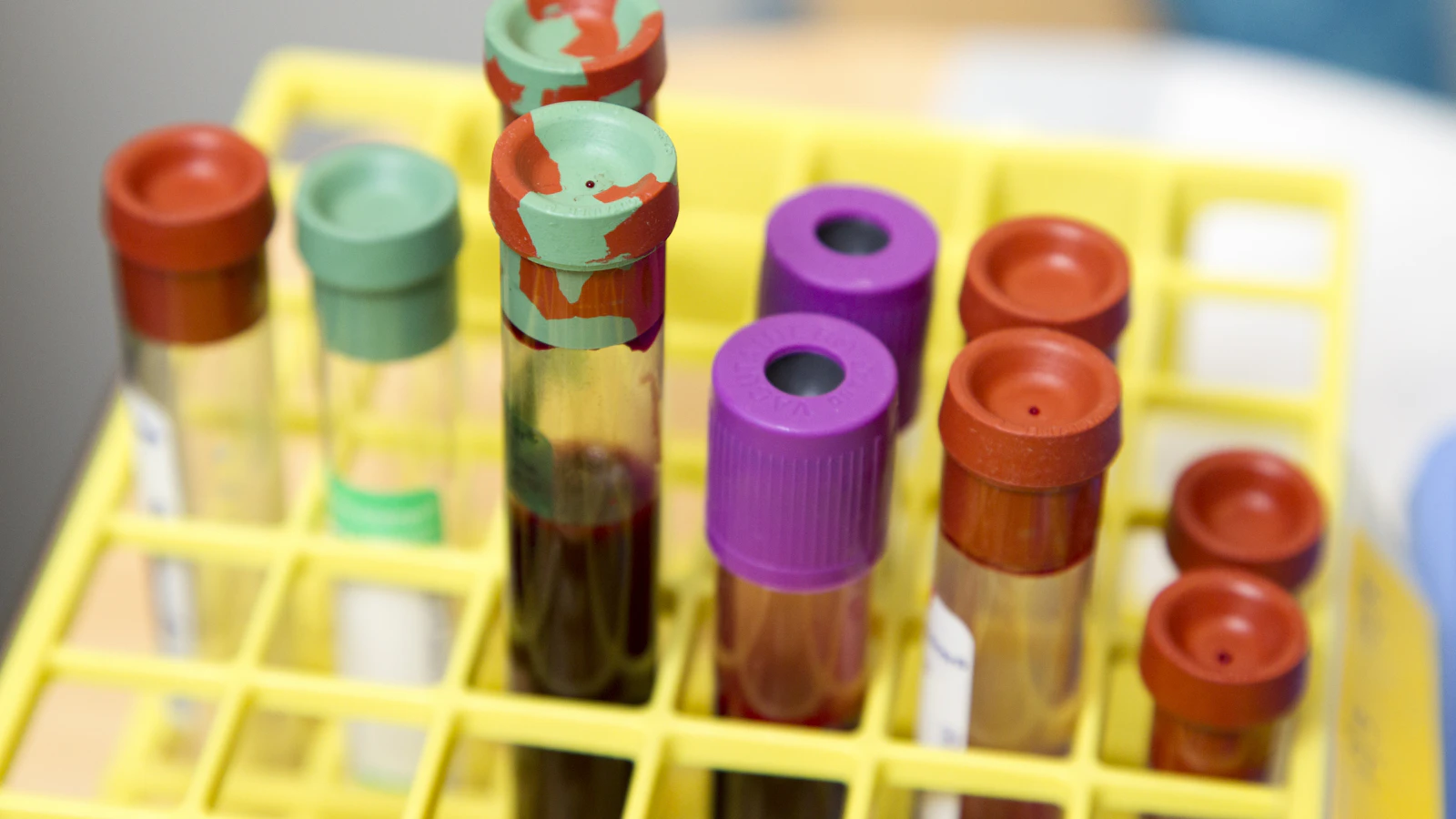
| Blood value | What it may relate to | Vitalcheck test |
|---|---|---|
| hs-CRP | Low-grade inflammation, a process often associated with ageing | Complete Metabolic Panel |
| Fasting glucose and HbA1c | How your body handles blood sugar over time | Complete Metabolic Panel |
| ApoB and LDL cholesterol | Factors related to heart and vascular health | Complete Metabolic Panel |
| eGFR and creatinine | Kidney function, which on average changes gradually with age | Extended Health Checkup |
| Homocysteine | Vitamin B status and vascular health | Extended Health Checkup |
That first row deserves a note. Chronic, low-grade inflammation recurs in the literature under the term "inflammaging". Researchers link that quiet inflammation to ageing and to cardiovascular disease (Ferrucci & Fabbri, Nature Reviews Cardiology, 2018). hs-CRP is one of the values that can make part of it visible.
Fasting glucose and HbA1c are about blood sugar. HbA1c gives a sense of your average blood sugar over the past weeks, so it can paint a calmer picture than a single fasting reading.
ApoB and LDL cholesterol belong to the heart and vessel story. ApoB counts the number of particles that carry cholesterol, and some researchers find that more informative than LDL alone.
eGFR and creatinine say something about your kidneys. Kidney function changes gradually with age on average, so these values come up more often in the context of ageing.
Homocysteine, finally, relates to your vitamin B status and to vascular health. It's a value you can partly influence with lifestyle and food.
The RIVM tracks figures on the health of the Dutch population and how it shifts with age. That kind of context helps you place your own values, though an individual result is always something you discuss with your GP.
Note: none of these values is an age meter on its own. They're pieces of a puzzle.
Can you lower your biological age?
Be careful with big words here. Some studies show that lifestyle relates to markers linked to ageing, but "reversing your biological age" is a claim that goes beyond what most measurements can support.
What does return fairly consistently: movement, sleep, food and not smoking relate to more favourable values for inflammation and blood sugar. That's not a guarantee and not treatment advice, but it's a direction the data often points in.

The nice part is that many of those habits act on the same values. More movement can relate to both calmer blood sugar and a lower inflammation value, for instance. So you don't have to turn ten dials at once.
The practical side, which habits relate to which values, we work out in lowering your biological age: what actually works. And if you want to know what's happening underneath, read how your body ages.
How reliable is a biological age test?
A biological age test gives an estimate, not an exact number. Two methods can sit years apart for the same person, and a single measurement says less than a series over time. Treat the outcome as a starting point for a conversation, not a final verdict.
There's noise in the mix too. A cold can lift your inflammation value temporarily, and a hard training session just before the draw can colour some values. That's why one loose result is harder to read than a line over time.
What does make a blood-based approach useful: you measure values you can track anyway. A series over the years says more than one snapshot.
If you want to look beyond single values, you could consider a complete metabolic panel or an extended health checkup. Athletes who link recovery and performance to blood values often find leads in blood values and longevity for athletes. And which values may be interesting per life stage, you'll read in which blood test by age.
Frequently asked questions about biological age
Is a lower biological age always better? A more favourable pattern of values is often seen as positive, but it stays an estimate. A nice number is no free pass, and a less nice number is no diagnosis.
Can my biological age be higher than my calendar age? Yes, it can. It means some measured values fit an older age on average. See it as a signal to take a look, not a reason to panic.
How often should you measure this? There's no fixed rule, and we don't give testing advice. Some people choose to track values periodically to see a line; what suits you is something you discuss with your GP.
Does a biological age test measure the same as a health check? Not quite. A health check looks broadly at separate values, while a biological age estimate tries to sum those values up in one number. They don't rule each other out; they complement each other.
What you can do with this
Biological age is no miracle and no exact science. It's a way of thinking about health that goes beyond the number on your birthday cake. If you want to make it concrete, start with a few blood values and follow them over time.
See a value that doesn't sit right? Discuss it with your GP. Every blood test result at Vitalcheck includes a professional assessment by a BIG-registered doctor. A blood value is not a diagnosis: always discuss symptoms and treatment decisions with your GP.
References
- López-Otín C, Blasco MA, Partridge L, Serrano M, Kroemer G. The hallmarks of aging. Cell. 2013. PMID: 23746838.
- Horvath S. DNA methylation age of human tissues and cell types. Genome Biology. 2013. PMID: 24138928.
- Ferrucci L, Fabbri E. Inflammageing: chronic inflammation in ageing, cardiovascular disease, and frailty. Nature Reviews Cardiology. 2018. PMID: 30065258.
- RIVM. Public health and care: health and age. Accessed 2026.
Author
Vitalcheck
Dr. Naimi, BIG-registered physician, oversees the medical standards behind our content and assessments. Read our medical policy
Related Tests
Related Posts

Testing your real age: which tests exist and what do they measure?

Ageing processes: what changes in your body over the years?