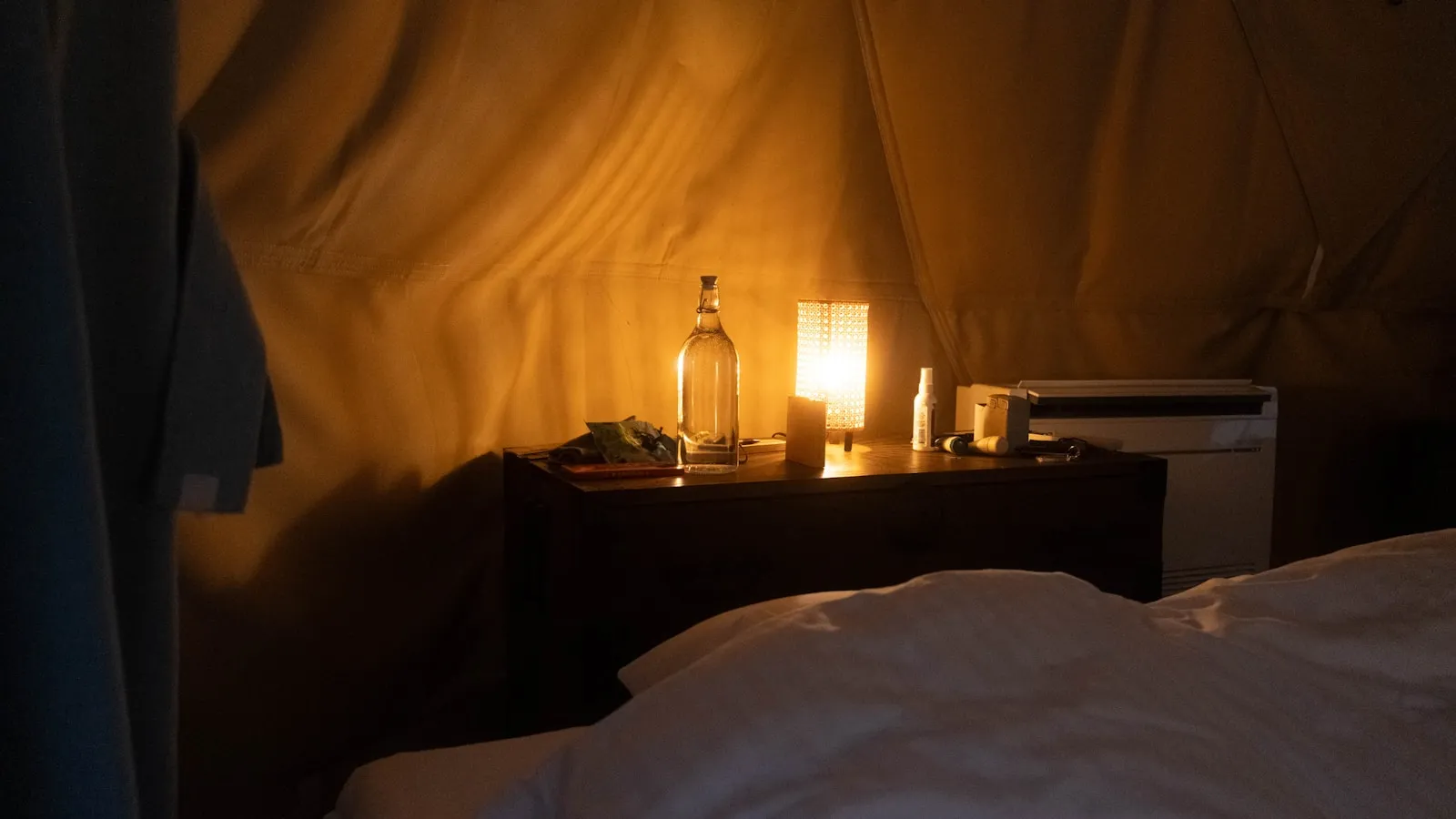
You wake at three in the morning in a soaked shirt, with the heating off for hours. Night sweats usually have an everyday explanation: a bedroom at 22 degrees, alcohol, shifting hormones, or a medicine you only started recently.
What strikes me about the Dutch and Belgian search results: almost all of them stop at "keep your bedroom cool". That helps sometimes. It tells you nothing about what you could measure when it doesn't.
This article does. For each cause it names the blood value that can offer insight, and the cases where blood testing adds nothing at all.
That second part is just as useful to know.
What causes night sweats?
Most causes fall into five groups: your sleep environment, your lifestyle (alcohol, spicy food, late training), your hormones (menopause and thyroid), your blood sugar, and medication. Infection and inflammation come after those. In many people two act at once, such as a warm room plus a glass of wine.
A systematic review by family medicine researchers found that sweating at night turns up alongside a wide spread of conditions. In general practice the explanation often stays ordinary (PMID 23136329). Rare causes get plenty of attention online. Frequent ones get much less.
That is the wrong way round.
The complaint is also more common than people assume. In a US study of primary care patients, a sizeable share reported sweating at night during the previous month (PMID 15506569). So you are not dealing with something exotic.
Alcohol deserves its own sentence. A drink makes falling asleep easier, but in the second half of the night your blood vessels widen and your heart rate rises. Perspiring around three or four o'clock fits that pattern.
Low blood sugar overnight can also produce sweating in some people, particularly in those taking glucose-lowering medication. Waking with hunger or shaky hands belongs to that picture.
Thuisarts.nl, the patient information that Dutch GPs write together with the NHG, frames excessive sweating as a complaint that needs context, not as a diagnosis on its own.
Why do men get night sweats?
In men the most common explanations are alcohol, excess weight combined with snoring, stress and medication. Lower testosterone can go together with hot flushes and sweating in some men, though it is rarely the only factor. Night sweats in men are barely covered separately in Dutch health information.
Sleep apnoea sits higher on that list than most people expect. Someone with breathing pauses at night wakes briefly dozens of times an hour. The body answers with a stress response, and sweating is part of it.
Snoring, a dry throat and daytime sleepiness are the matching signals. Blood tests do not measure sleep apnoea. That needs a sleep study, arranged through your GP.
Medication is the second blind spot. Some antidepressants, certain heartburn drugs and some painkillers are known for sweating as a side effect. If the sweating started within a few weeks of a new prescription, write that down.
Add the date. A timeline often says more than a result.
When sweating comes with low energy and reduced libido, doctors sometimes look at testosterone as well. What that value does and does not say sits in the article on testosterone levels in men.
Can menopause cause night sweats?
Yes. Night sweats and hot flushes are the best known vasomotor symptoms of perimenopause and menopause. They arise because fluctuating oestrogen makes the thermostat in your brain more sensitive to small temperature differences. Half a degree can then be enough to set off a sweat.
These symptoms last longer than most women expect. In the US SWAN study, frequent hot flushes and night sweats persisted for a median of roughly seven years across the whole transition (PMID 25686030).
Seven years is not a typo.
Sweating episodes often begin in perimenopause, while periods still arrive on time. That is what makes it confusing: your cycle looks normal, your nights do not. Menopausal sweating therefore gets recognised late.
FSH and oestradiol can offer insight here, with a caveat. During perimenopause both values swing from month to month. A single measurement therefore says less than the pattern plus your symptoms. There is more on this in our piece on which blood test gives insight during menopause.
Which blood values give insight into night sweats?
There is no blood value for night sweats themselves. Several values can offer insight into the causes behind them. Think of TSH and free T4 for your thyroid, and FSH and oestradiol around menopause. Fasting glucose and HbA1c cover your blood sugar, with hs-CRP and a blood count when inflammation is suspected.
The table below links each common cause to what else you would notice, and to the value that fits it. For two causes there is deliberately no value listed.
| Possible cause | What else you notice | Blood value that can give insight |
|---|---|---|
| Menopause or perimenopause | Hot flushes during the day, irregular cycle, mood swings | FSH and oestradiol, timed to your cycle day |
| An overactive thyroid | Palpitations, weight loss, trembling hands, poor heat tolerance | TSH and free T4 |
| Swinging or low blood sugar | Waking hungry, shaky or with palpitations, often around three o'clock | Fasting glucose and HbA1c |
| Infection or inflammation | Fever, malaise, symptoms that run on for weeks | hs-CRP and a full blood count |
| Alcohol or medication | Sweating in the second half of the night, or soon after a new prescription | No blood value: take your medication list to your GP |
| Sleep apnoea | Snoring, breathing pauses, morning headache, daytime sleepiness | No blood value: this needs a sleep study |
The table is an aid, not a result. Every laboratory sets its own reference ranges, and the range printed beside your own result is the range that counts.
Take two women of 48 who both wake up soaked three nights a week. The first has a TSH of 0.2 mIU/L with a free T4 at the top of its range. The second has a TSH of 1.8 mIU/L and an FSH of 42 IU/L.
Same complaint, two very different conversations. For the first, a thyroid running faster fits the picture better; for the second, menopause does. Which of the two it is, your GP assesses, not the table.
An overactive thyroid usually produces more than sweating alone: palpitations, unintended weight loss, trembling hands and poor heat tolerance (PMID 37847271). With that picture, TSH is the value a doctor looks at first, with free T4 beside it.
What strikes me most here: people test all sorts of things except the two values that match their own symptom pattern. A targeted question returns more than a broad one.
To have your thyroid measured, the thyroid function test fits that question. If menopause plays a part, hormones women suits it better. If the sweating comes with persistent tiredness, our overview of causes of fatigue gives the wider context.
When are night sweats a reason to see your GP?
When they run on for weeks without a clear explanation, and certainly when other symptoms join them. Unintended weight loss, fever that keeps returning, swollen lymph nodes or a cough that will not settle belong in that category. An assessment by your GP is then the logical next step.
This is the part where websites go either too light or too heavy. I find both useless to someone lying awake at four in the morning.
- Usually ordinary. Sweating tied to heat, alcohol, stress, hormones or a new medicine is by far the most frequently found explanation.
- Worth raising. Sweating that is new for you, returns almost every night and lasts longer than a few weeks.
- Raise sooner. Sweating together with fever, unintended weight loss or swollen lymph nodes.
That last combination says nothing on its own about a cause. It is the reason a doctor wants to look at it in person, rather than you reading about it.
Before that appointment, note how often it happens, how long it has been going on, whether you have to change clothes, and which medicines you take. That list makes the consultation far more concrete.
What can you change yourself before testing anything?
Start with what you can try within a week: bedroom temperature, your duvet, alcohol in the evening and the timing of your last heavy meal. Track for two weeks what you change and what it does. If the sweating stays after that, the question you bring to your GP gets sharper.
A bedroom around 17 to 19 degrees suits many people better than 22. A thick duvet with a synthetic cover traps moisture. You only notice that once you swap it.
Alcohol is best moved earlier in the evening, or you skip two evenings to see the difference. For me that was the clearest experiment of the lot.
If you mainly wake without sweating, something else is probably at play. The article on waking up at night covers that. For what else has evidence behind it when sleep is poor, we have set out what actually works according to research.
Concretely: keep a short two-week log of your nights, your alcohol, the room temperature and your medicines. Bring it to your GP and ask which two values fit your pattern. That is a better question than "can I test everything".
References
- Mold JW, Holtzclaw BJ, McCarthy L. Night sweats: a systematic review of the literature. J Am Board Fam Med. 2012;25(6):878-893. PMID 23136329.
- Mold JW, Mathew MK, Belgore S, DeHaven M. Prevalence and predictors of night sweats, day sweats, and hot flashes in older primary care patients: an OKPRN study. Ann Fam Med. 2004;2(5):391-397. PMID 15506569.
- Avis NE, Crawford SL, Greendale G, et al. Duration of menopausal vasomotor symptoms over the menopause transition. JAMA Intern Med. 2015;175(4):531-539. PMID 25686030.
- Lee SY, Pearce EN. Hyperthyroidism: a review. JAMA. 2023;330(15):1472-1483. PMID 37847271.
- Thuisarts.nl and the NHG. Patient information on excessive sweating, sleep problems and menopause. Available via thuisarts.nl.
This article is informational and does not replace medical advice. Blood values are a snapshot and say nothing about a diagnosis on their own. Every result at Vitalcheck is reviewed by a BIG-registered doctor. If your symptoms persist or get worse, contact your GP.
Autor