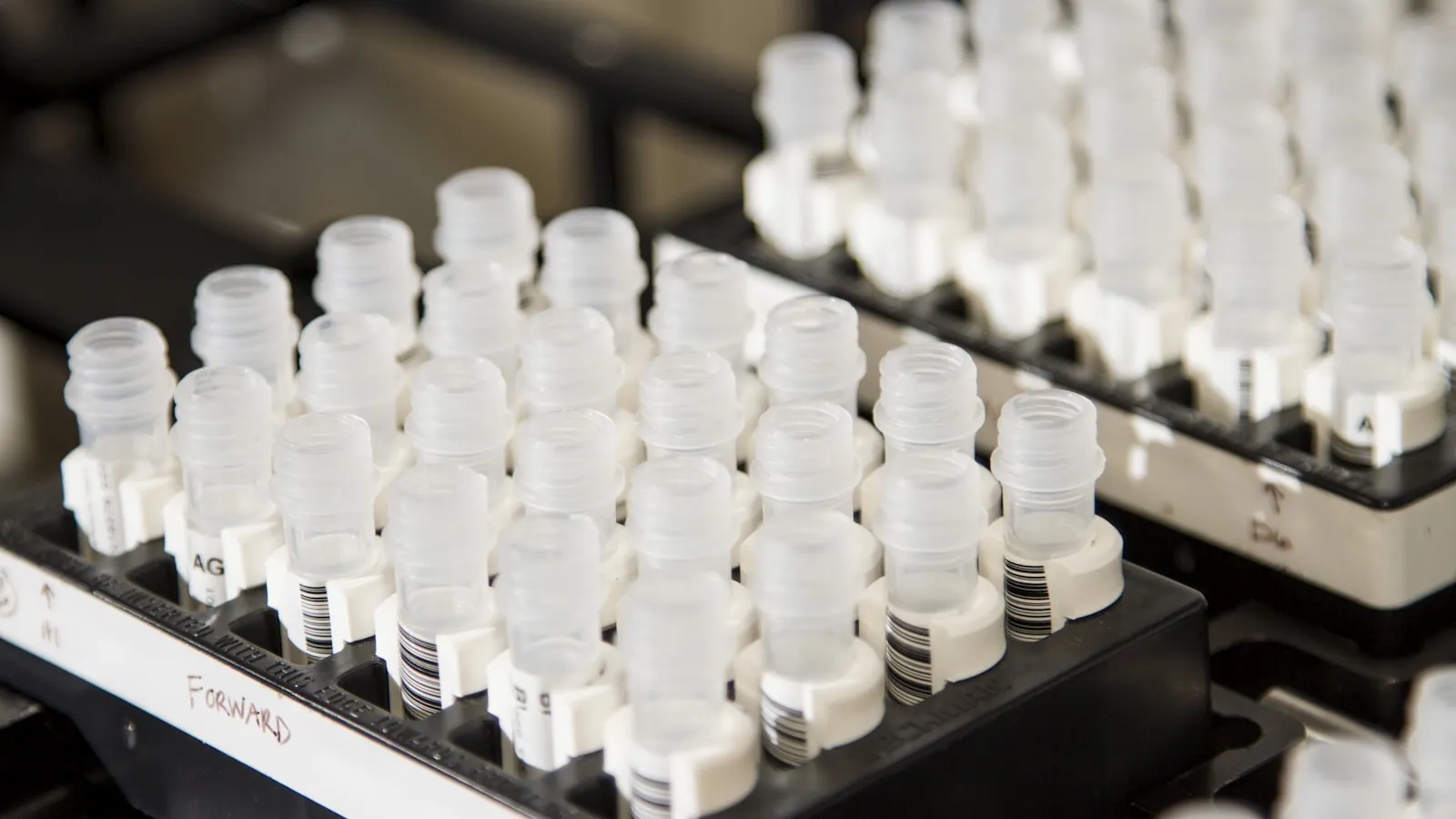
It is eleven at night. You scroll through your result and one line sits in red: eosinophils, just above the upper limit. You type "high eosinophils" into Google.
Two clicks later you are reading about bone marrow, about hypereosinophilic syndrome, about cancer. That is exactly the problem this article wants to fix.
My view, after years of explaining results to people who have had a fright: the internet reacts here entirely out of proportion. In most people a mildly raised eosinophil count comes from something mundane. Think allergy, hay fever, asthma, a parasite or a medication (PMID 27866580).
The rare causes do exist. They deserve serious attention, but only at numbers that sit well above most results. Where that line roughly falls, you can read below.
What are eosinophils?
Eosinophils are white blood cells that belong to the leukocyte differential, the breakdown of your white blood count. They play a role in allergy and in defence against parasites. Normally these eosinophil granulocytes make up only a few percent of all your white blood cells.
Their work is blunt. They release substances that damage parasites, and those same substances irritate your own tissue during an allergic reaction. That is why they turn up in hay fever, asthma and eczema.
On your result they usually appear twice: as a percentage of your white blood cells, and as an absolute count per litre of blood. That second number is the one that counts. What the rest of your white blood count does is explained in the article on leukocytes and their normal value.
When are eosinophils too high?
Doctors usually speak of high eosinophils from roughly 450 to 550 cells per microlitre, which comes to about 0.5 ×10⁹/L (PMID 27866580). The absolute count weighs more heavily than the percentage. A percentage can rise purely because your total white blood cells fall.
| Level | Absolute count (indicative) | What this usually means |
|---|---|---|
| Normal | up to about 0.5 ×10⁹/L | No sign of eosinophilia |
| Mildly raised | about 0.5 to 1.5 ×10⁹/L | Often allergy, hay fever, asthma, eczema or a medication |
| Clearly raised (hypereosinophilia) | above about 1.5 ×10⁹/L | Deserves a medical work-up, even without symptoms |
The numbers in this table are indicative. Every laboratory applies its own reference ranges, and the range printed on your own result is the range that counts. Above roughly 1.5 ×10⁹/L doctors speak of hypereosinophilia, and that is the level that genuinely calls for investigation.
Take two people, both with 8 percent eosinophils. In the first, leukocytes sit at 9.0 ×10⁹/L, so the absolute count works out at 0.72 ×10⁹/L: mildly raised. In the second, leukocytes sit at 3.5 ×10⁹/L, so 0.28 ×10⁹/L: perfectly normal.
Same percentage, opposite conclusion.
What can a raised eosinophil count mean?
Usually something mundane, and that is not a consolation prize but statistics. Allergy, hay fever, asthma and eczema top the list, followed by a parasitic infection and a reaction to a medication. Autoimmune disease can raise the count too, and a blood disorder sits right at the bottom (PMID 27866580).
That ordering by frequency is exactly what the search results do not tell you.
Allergic conditions are by far the most common explanation. In hay fever, eosinophils climb during the pollen season and settle again afterwards. Give blood in May and you measure something different from November.
Asthma is the second large group. Longfonds, the Dutch lung foundation, describes asthma as chronic inflammation of your airways, and in a share of people with asthma the eosinophils are precisely the cells carrying that inflammation.
Medications are often forgotten. Antibiotics, anti-inflammatories and some anti-epileptics can raise your eosinophils without any further symptoms. So bring your medication list when you discuss your result.
Parasites are unusual in the Netherlands, but not impossible. A recent trip to the tropics changes that likelihood considerably. That is also why your GP asks about travel history before ordering anything further.
If you want to know whether an allergy sits behind it, a raised eosinophil count on its own is too vague. Then you look further at what a raised IgE level means, or specifically at which blood test shows a pollen allergy.
Important: a severe allergic reaction is never a blood-test question. With breathlessness, swelling of your lips, tongue or throat, or other signs of anaphylaxis, call 112 or go to the out-of-hours GP service. That is acute care, and it cannot wait for a result.
How do I lower my eosinophils?
You do not lower the number, you address the cause. No diet, supplement or lifestyle trick has been shown by research to bring eosinophils down reliably. Once the allergy is treated or the medication causing the reaction is gone, the value drops along with it.
Which cause applies to you is not something you settle alone. Discuss your result with your GP, certainly if symptoms come with it. Thuisarts, the Dutch GP-backed patient site, is where that patient information lives.
There is something else you rarely read. Antihistamines and certainly corticosteroids can suppress your eosinophils temporarily. Give blood in the middle of a prednisone course and your result can look reassuringly low while something is genuinely going on.
It works the other way round too. Stop such a drug and the value can climb again. So always note on your request form which medications you take, and never stop a prescribed medication on your own.
What is tryptase and when does that value matter?
Tryptase is an enzyme from your mast cells, a different immune cell from the eosinophil. The baseline tryptase in your blood says something about how many mast cells you have. Doctors order it after severe allergic reactions, when a mast-cell disorder is suspected, and sometimes alongside a raised eosinophil count.
Mast cells are also the cells that release histamine, the substance behind itching, sneezing and a runny nose. How that system works, and what your blood does and does not say about it, sits in our overview of histamine intolerance.
Here is the reassuring fact almost nobody mentions. Normal baseline tryptase runs roughly from 1 to 15 ng/mL (PMID 37572755). That upper limit is drawn deliberately wide: healthy people with hereditary alpha-tryptasemia still fall inside it.
Hereditary alpha-tryptasemia sounds heavy, but it is mostly a common inherited trait. Extra copies of the TPSAB1 gene give a higher baseline tryptase, without disease having to be involved (PMID 30007465).
So a higher baseline tryptase is far from always a sign of illness.
The experts behind that range wrote down why they drew it that way: to avoid overinterpretation, needless referrals and needless anxiety (PMID 37572755). I think that is one of the most honest sentences in the allergy literature. We wish more guidelines said it out loud.
If you want tryptase measured, you can pick it separately via the tryptase blood value. Do not order it on your own hunch for a vague complaint: let your GP help decide whether it adds anything for you.
What do you do with a raised result?
One raised value is a snapshot, not a diagnosis. Eosinophils fluctuate with the season, with an infection and with the medications you take. A repeat measurement a few weeks later, read alongside your symptoms and your medication list, says far more than that first number.
Discuss that result with your GP.
Do not wait if your value is clearly raised and you also have unintended weight loss, fever or night sweats. That combination belongs with a doctor, not with a self-ordered repeat test.
If your eosinophils are raised without those warning signs, a doctor looks at the whole picture first: your story, your medications, travel abroad and your earlier results. Only then does further testing follow. The UK haematology guideline describes such a stepwise approach (PMID 28112388).
To follow your own value, you can pick eosinophils and the leukocyte differential through building your own blood test. Read them next to your inflammation markers, because CRP and ESR give context that a single cell count misses.
Concretely: write down your value, add your medications, list your symptoms from recent months and put that note in front of your GP. Ask whether a repeat measurement makes sense for you. That is a better next step than another hour of searching online.
References
- Kovalszki A, Weller PF. Eosinophilia. Prim Care. 2016;43(4):607-617. PMID 27866580.
- Butt NM, Lambert J, Ali S, et al. Guideline for the investigation and management of eosinophilia. Br J Haematol. 2017;176(4):553-572. PMID 28112388.
- Valent P, Hoermann G, Bonadonna P, et al. The Normal Range of Baseline Tryptase Should Be 1 to 15 ng/mL and Covers Healthy Individuals With HαT. J Allergy Clin Immunol Pract. 2023;11(10):3010-3020. PMID 37572755.
- Lyons JJ. Hereditary Alpha Tryptasemia: Genotyping and Associated Clinical Features. Immunol Allergy Clin North Am. 2018;38(3):483-495. PMID 30007465.
- Longfonds and Thuisarts. Patient information on asthma, allergy and blood testing. Available via longfonds.nl and thuisarts.nl.
Every blood test result at Vitalcheck includes a professional assessment by a BIG-registered doctor. A blood value is not a diagnosis: always discuss treatment decisions with your GP.
Autor
Vitalcheck
Powiązane badania
Powiązane artykuły

ANA blood test: what a positive ANA does and does not mean
Rheumatoid factor: what a positive or negative result means