Strength training will not make you lean. Exercise on its own produces about 1.6 to 1.7 kg of weight loss over six to twelve months (PMID 21787904). Yet strength training belongs in every weight-loss plan. Not to burn calories, but to keep the muscle you would otherwise lose.
That difference shapes how you train, how much protein you eat and how fast you lose.
Why exercise is a weak weight-loss engine
Movement is good for your heart, your blood sugar and your head. As a standalone weight-loss method it is weak. Exercise without any change to your food produces about 1.6 to 1.7 kg over six to twelve months (PMID 21787904).
Your body also cancels part of the bill. Roughly 28% of the energy you burn in activity is compensated away elsewhere in the day (PMID 34453886). You move less afterwards and you eat a little more.
So a hard session is not a licence to eat. It is also not a failure. The point of the gym is simply a different one.
What you actually lose when the scale drops
Weight loss is never pure fat. Around 20 to 25 percent of what you lose is fat-free mass: muscle, water, glycogen and connective tissue. That is not a scandal. That is the baseline.
Your job is to make that share as small as possible, not to reach zero.
Fat-free mass is your engine. It keeps you strong, holds up your resting metabolic rate and makes maintenance easier later. Losing weight while getting weaker is not the result you signed up for.
The two levers that work
Two things protect muscle in a deficit: enough protein and resistance training. Together they beat either one alone. In a study using a steep deficit and hard training, fat-free mass rose 1.2 kg on 2.4 g of protein per kg, while fat fell 4.8 kg (PMID 26817506).
The comparison group ate 1.2 g/kg. They lost fat too, but their fat-free mass stayed flat.
A meta-analysis of higher-protein diets shows the same pattern. People eating more protein retained 0.43 kg more fat-free mass and lost 0.87 kg more fat (PMID 23097268). The numbers are not spectacular. They are consistent.
Resistance training is the signal. Protein is the building material. Without the signal, your body has no reason to keep that muscle.
How much protein per day to lose weight?
For most people, about 1.6 g of protein per kg per day is enough. If you lift, go towards 2.0 g/kg. The International Society of Sports Nutrition puts the range at 1.4 to 2.0 g/kg per day (PMID 28642676). Above roughly 1.6 g/kg the benefit levels off (PMID 28698222).
The Dutch Voedingscentrum uses 0.8 g per kg as the general adult figure. That is a floor against deficiency. It is not the amount that protects muscle while you are losing weight.
Scale it to a reference weight, not your current weight
This is where most calculators go wrong. At 120 kg, 2 g/kg works out at 240 g of protein a day. Fat mass has no protein requirement.
So use a reference weight instead. If you know your fat-free mass, use 2.3 to 3.1 g per kg of fat-free mass (PMID 24092765). If you do not, take your height in centimetres minus 100 as a reference figure in kilograms.
At 180 cm that gives 80 kg. This is a calculation aid for your protein intake. It is explicitly not a target weight and not a goal.
| Reference weight | 1.6 g/kg per day | 2.0 g/kg per day if you lift | Per meal across four meals |
|---|---|---|---|
| 60 kg | 96 g | 120 g | 24 to 30 g |
| 70 kg | 112 g | 140 g | 28 to 35 g |
| 80 kg | 128 g | 160 g | 32 to 40 g |
| 90 kg | 144 g | 180 g | 36 to 45 g |
| 100 kg | 160 g | 200 g | 40 to 50 g |
Spread it across the day
Protein works best in portions. Aim for at least 0.25 g per kg per meal, spread across three to four eating moments (PMID 28642676). One large evening plate rarely gets there.
In practice: eggs or quark at breakfast, pulses or fish at lunch, chicken, tofu or tempeh with the main meal. Plant-based works fine. You simply need a little more volume.
How fast can you lose without giving up muscle?
Rate is the third lever. Athletes losing about 0.7% of bodyweight per week actually gained lean mass. At about 1.4% per week, they did not (PMID 21558571).
A workable band is 0.5 to 1.0% of bodyweight per week. Slower loss also sits better alongside training you can keep doing.
How to build that deficit is covered in our article on calculating a calorie deficit. Strength training does not change that arithmetic. It changes what you lose inside it.
What the training looks like
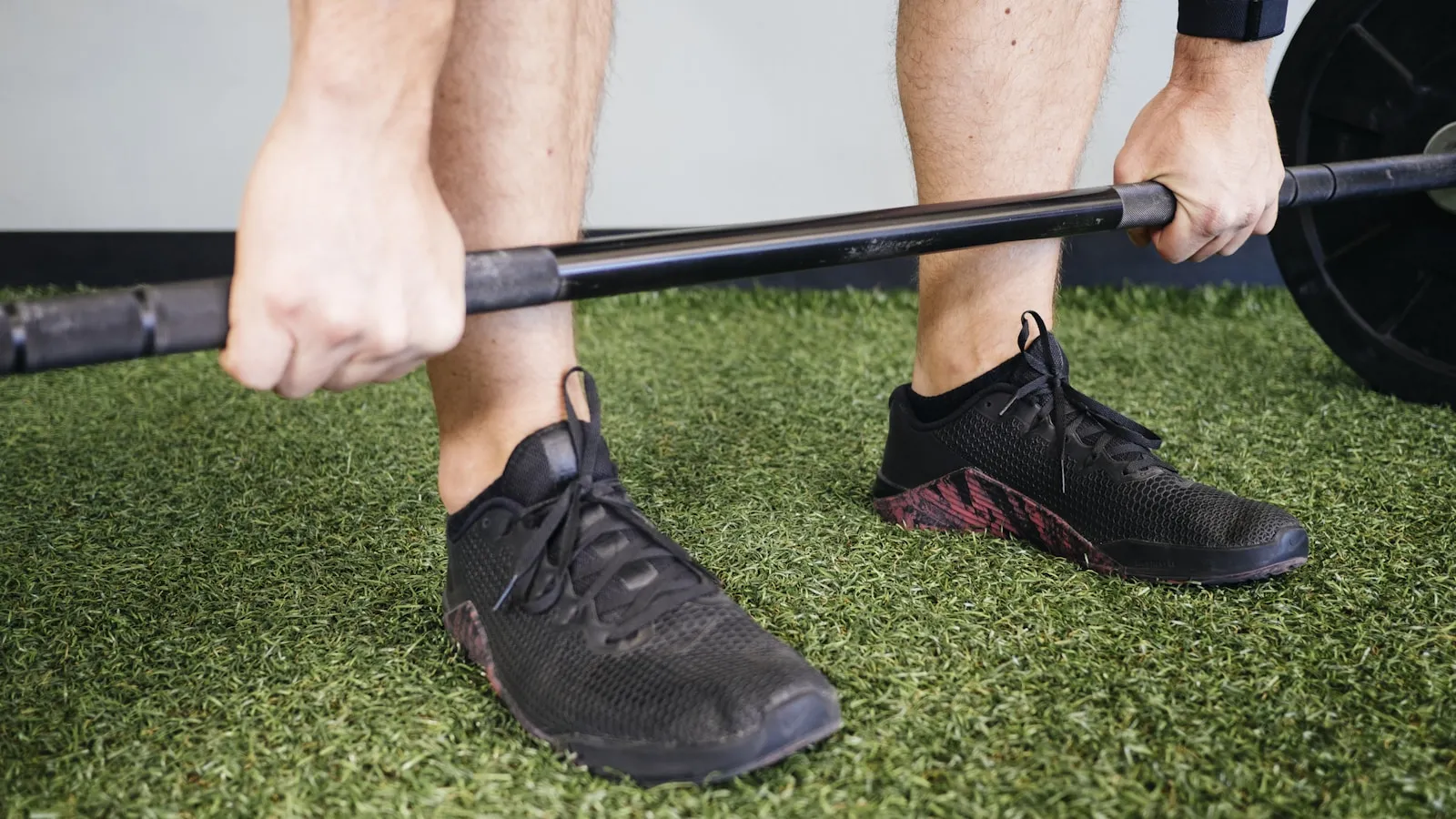
You do not need a complicated programme. Two to three sessions a week is enough, with compound lifts and sets taken close to the point where one more repetition would be hard.
Think of a squat, a hip hinge, a push, a pull and one trunk exercise. Machines count fully. Resistance bands and bodyweight count too, as long as you track progression.
Keep getting stronger, or at least hold your loads through the deficit. That is your main gauge. The scale says far less here.
Is a lot of protein bad for your kidneys?
Not with healthy kidneys. A higher protein intake does not damage healthy kidneys, including over longer periods. Existing kidney disease is a genuine exception, and there your doctor's advice applies.
We looked at this separately in our article on high-protein eating and your kidneys. If you take medication or have a known kidney condition, speak to your GP first.
Two myths you can drop
Strength training makes women bulky. It does not. Building muscle is slow and hard work, especially in a calorie deficit. What women report in practice is more strength and a firmer shape at the same weight.
Cardio burns your muscle. Also false. What costs you muscle is a large deficit with no resistance stimulus and not enough protein.
So walk, cycle or swim. Do it alongside your strength training, not instead of it.
What a blood test does and does not do here
A blood test will not tell you why the scale has stopped moving. In healthy people, hormone panels are rarely the explanation. If you hit a plateau, the answer nearly always sits in energy balance rather than your hormones.
What blood values do show is what your weight is doing to your health. Fasting glucose, HbA1c, your lipids and your liver values all move as you lose weight and train.
If you want that change on paper, our complete metabolic panel measures those values before and after. Not to explain why it is not working. To show you that it is.
When this article is not for you
Weight loss is not a healthy goal for everyone. Do not follow this article if you have or have had an eating disorder, are pregnant or breastfeeding, are under 18, are underweight, use insulin, or have had bariatric surgery. Speak to your GP first.
If thoughts about food or your body start to take over, talk to your GP or contact an eating disorder helpline. That is not weakness. That is sense.
What to do this week
Put two strength sessions in your calendar and write down your load and repetitions for each exercise. Then set your protein target with the table above and count one ordinary day of intake.
The full step-by-step plan sits in our pillar on healthy weight loss according to the science. This article is the chapter that protects your muscle.
الوسوم
الكاتب