Your haematocrit level is the percentage of your blood made up of red blood cells. In men it usually sits between 0.41 and 0.50 l/l, in women between 0.36 and 0.47 l/l. If your report says 0.42 and you are a woman, you are comfortably inside the range.
That is the answer. The rest of this page is about the question that comes next.
Here is what strikes me about this topic. People search for their own number, things like "haematocrit 0.39" or "0.42 female". Then they land on a page that lists one reference range and says nothing about their actual figure.
We wanted to fix that. Below you will find a table where you can look up your own value, followed by the reason that number can shift without anything being wrong.
What is haematocrit?
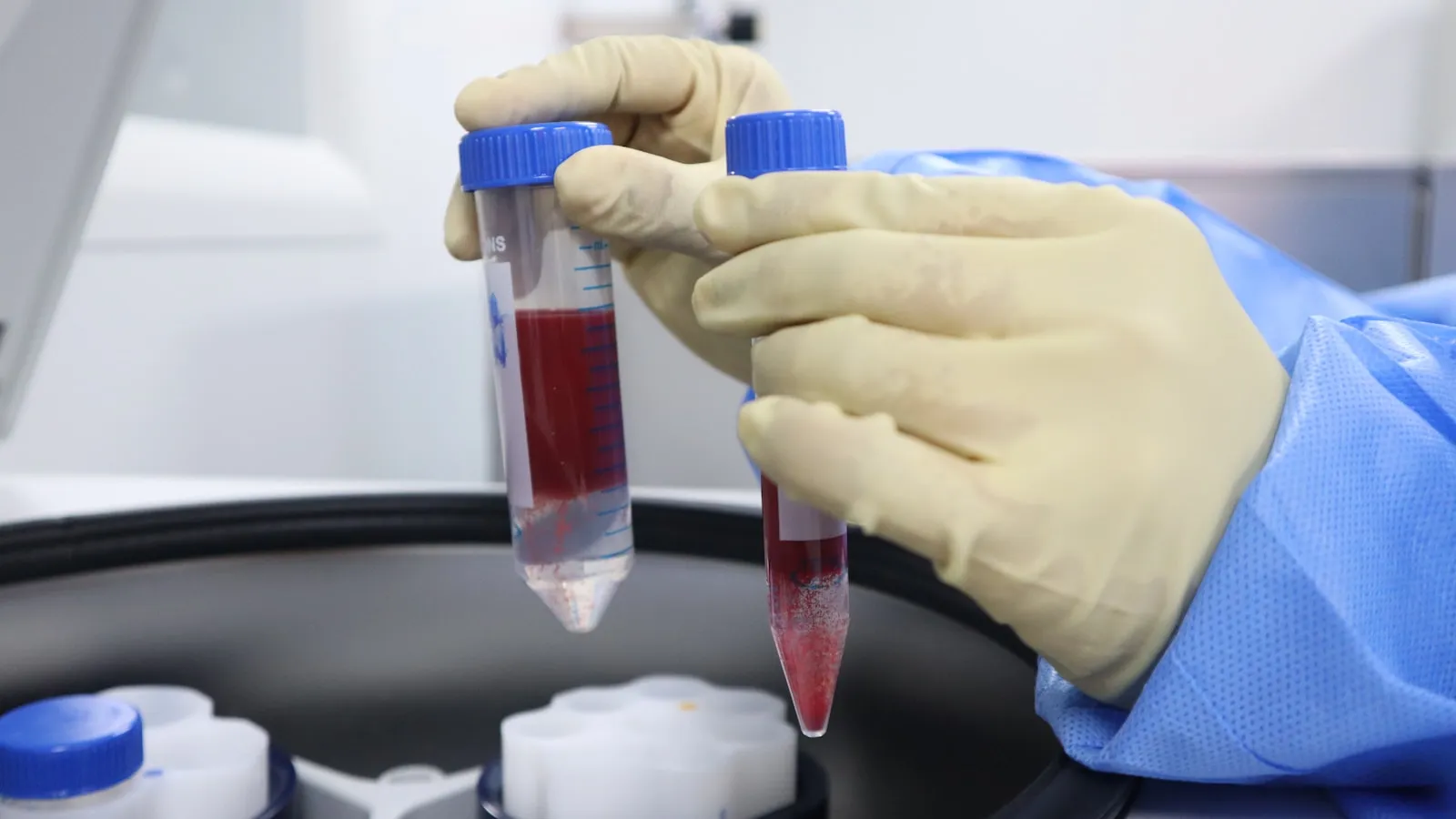
Haematocrit, usually shortened to Ht or Hct, is the share of your blood volume made up of red cells. Spin a tube of blood in a centrifuge and the red cells sink. The height of that layer divided by the total is your haematocrit. That is all it is.
Dutch labs normally report it as a number between 0 and 1, for example 0.44 l/l. Some labs write it as a percentage instead: 44 percent. Same value, different notation.
Those two notations cause a lot of confusion.
If your report says 0.44 and you read somewhere that 44 is normal, they are the same number. Multiply by a hundred and you have the percentage.
Ht almost never appears on its own. It belongs to the complete blood count, alongside your haemoglobin, your red cell count and a row of derived figures.
What is a normal haematocrit level?
For adult men the reference range runs roughly from 0.41 to 0.50 l/l, and for adult women from 0.36 to 0.47 l/l. Women sit structurally lower, largely because of menstrual blood loss and lower testosterone. Children have their own ranges that shift with age.
Note the word "roughly". Every laboratory sets its own reference values, based on its own analysers and its own population. A range that runs to 0.47 at one lab may stop at 0.45 at the next.
| Group | Range in l/l | As a percentage |
|---|---|---|
| Men (adult) | 0.41 to 0.50 | 41 to 50 percent |
| Women (adult) | 0.36 to 0.47 | 36 to 47 percent |
| Women (pregnant, second trimester) | often 0.32 to 0.42 | 32 to 42 percent |
| Children (1 to 6 years) | about 0.32 to 0.42 | 32 to 42 percent |
So always compare your result against the range printed on your own lab form, not against a range from a random website. Including this one.
My haematocrit is 0.42. What does that mean?
It depends on your sex. For a woman, 0.42 is an ordinary value sitting comfortably inside the range. For a man it is also inside the range, but towards the low end. Same number, two different conversations. That is exactly why a single reference range tells you so little.
Below is the table we could not find on any other page about this topic. Look up your own value.
| Your Ht in l/l | Woman | Man |
|---|---|---|
| below 0.30 | clearly low | clearly low |
| 0.30 to 0.35 | low | low |
| 0.36 to 0.40 | in range, towards the low end | low to borderline |
| 0.41 to 0.47 | in range | in range |
| 0.48 to 0.50 | just above range | in range, towards the high end |
| 0.51 to 0.54 | raised | just above range |
| above 0.54 | clearly raised | raised |
This grid is a reading aid, not a diagnosis. A value just outside the range is unremarkable in many people, and a value inside the range rules nothing out.
Picture two women who both have 0.37 printed on their report. The first feels fine and had 0.38 last year. The second has been tired for months and had 0.44 last year.
Same number. Only the second story asks for a follow-up.
The trend across your own results usually says more than the comparison with everyone else.
What does a low haematocrit mean?
A low haematocrit means there are relatively few red cells in your blood. That can happen because you make too few, because you lose them, or because they break down faster than usual. Iron deficiency is the most common cause in the Netherlands, particularly in women who menstruate.
A low Ht often travels with a low haemoglobin. In practice doctors call that anaemia, and Thuisarts sets out the usual next steps for it.
Other causes that come up regularly include a vitamin B12 or folate deficiency, chronic inflammation, reduced kidney function, and blood loss from the gut that you never see.
Pregnancy also lowers your Ht, and that is usually not a deficiency. Plasma volume rises faster than the red cell count, which effectively dilutes the blood.
That distinction matters. Dilution and production problems both produce a low number, but they are different things.
If you want to know which way yours points, your MCV is the next value to look up. It tells you whether your red cells are small, normal or large, which splits the list of causes in two straight away.
What does a high haematocrit mean?
A raised haematocrit means red cells make up a larger share of your blood than expected. In the large majority of cases that is because your plasma volume has dropped, not because you have made more cells. Dehydration is the classic cause, and it is benign and temporary.
Smoking raises Ht structurally, because carbon monoxide occupies part of your haemoglobin and the body compensates with more red cells. Sleep apnoea and time spent at altitude do something similar.
There is also a medication angle many people do not know about. SGLT2 inhibitors, a group of diabetes drugs, measurably raise haematocrit, which can mask an underlying anaemia (PMID 37698758).
Testosterone therapy does the same, which is one reason the blood count is monitored as standard during that treatment.
If your Ht stays high while you drink enough, do not smoke and take none of those drugs, polycythaemia vera comes into view. That is a rare bone marrow disorder in which genuinely too many red cells are produced (PMID 34060791).
Rare here really does mean rare. The overwhelming majority of raised results we see come down to not enough water on the day of the draw.
How high can haematocrit safely be?
There is no single threshold that applies to everyone. Above roughly 0.52 l/l in men and 0.48 l/l in women is generally treated as raised, but the number at which a doctor acts depends on your symptoms, your medication and your previous results.
What a doctor mainly wants to know is whether the value is new. A man who has sat around 0.51 for ten years is a different case from a man who had 0.44 last year and 0.53 now.
So discuss a raised result with your GP, and bring your earlier results if you have them.
Why dehydration distorts your haematocrit
Haematocrit is a ratio, not a quantity. Lose fluid and your plasma volume falls while your red cell count stays put. The ratio shifts upward without a single extra cell being made. That is the most important thing to understand about this value.
The shift is not small. During exercise and heat, plasma volume can drop by a substantial percentage, with a directly measurable effect on blood values (PMID 3880897). Posture counts too: half an hour standing gives a different result from half an hour lying down.
Research into fluid intake shows the same pattern, with hydration markers tracking how much someone drinks (PMID 25564016).
In practice this means the following. Draw blood at eight in the morning after a warm night with nothing to drink and your Ht can come out higher than it would at eleven the same week with two glasses of water in you.
So do not turn up at the draw site dehydrated. Drink water, even when you have to fast, unless you have been told otherwise.
Haematocrit in women, pregnancy and children
Women average a lower haematocrit than men, roughly 0.36 to 0.47 l/l against 0.41 to 0.50 l/l. In pregnancy the value drops further, usually to somewhere between 0.32 and 0.42 l/l, because plasma volume rises more than the red cell count does.
In children the ranges move with age. A newborn sits considerably higher than a toddler, and a teenager approaches the adult ranges.
So a child result cannot be judged against an adult table. Ask for the age-appropriate range from the doctor who ordered the test.
In menstruating women there is one more reason not to panic at a low value: heavy menstrual bleeding is a common cause of iron deficiency, and your ferritin often shows that before your haematocrit does.
Which values do you read beside your haematocrit?
Haematocrit says little on its own. The two values that belong beside it are your haemoglobin, which nearly always moves the same way, and your MCV, which describes the size of your red cells. Together they tell you whether a low value fits iron deficiency or comes from somewhere else.
Your report also carries a few numbers most people skip. They are the useful ones when you want to know where a deviation came from.
- MCH shows how much haemoglobin an average red cell carries.
- MCHC sets that amount against the volume of the cell, and is the index most often skewed for a technical reason.
- RDW describes how much your red cells vary in size, and often rises first in early iron deficiency.
On the white side of the count sit two more figures, read separately from your Ht but printed on the same form: neutrophils and monocytes.
For the wider picture, see our guides to haemoglobin and erythrocytes.
Can you raise your haematocrit yourself?
Only if there is a cause you can address. If your value is low because of iron deficiency, it rises as that deficiency is treated. If it is low because of pregnancy, chronic illness or dilution, food changes little. No diet raises Ht independently of the cause.
That is a dull answer, and it is the honest one. The internet is full of iron-rich food lists, as though the cause were beside the point.
The order runs the other way. Work out why the value is low, then act.
RIVM tracks how dietary intake is distributed across the Netherlands, and the NHG guidelines describe how GPs work up anaemia. Both assume that same order.
When should you test again?
For a slightly abnormal value without symptoms, a repeat after a few weeks is usual, so a one-off outlier drops out. Draw at the same time of day and under the same conditions as the first test, because that removes the largest source of noise from the comparison.
If you have symptoms that fit anaemia, such as persistent tiredness, breathlessness on exertion or pallor, do not wait for a repeat and discuss the result with your GP.
To measure your haematocrit alongside the rest of your blood count, it is included in our basic health checkup. You can also add it on its own through your own custom blood test, and the background to the marker sits on our haematocrit page.
My advice stays simple: bring your previous result to the appointment. A second number turns a snapshot into a line, and the line is what a doctor reads.
Frequently asked questions
Is haematocrit the same as haemoglobin? No. Haemoglobin is the protein that carries oxygen; haematocrit is the volume share of the cells that contain it. They usually move together, but they measure different things.
What does Ht mean on my report? Ht is the usual abbreviation for haematocrit. Some labs print Hct.
Do I need to fast for this test? Not for haematocrit itself. It is often drawn as part of a panel that does contain values where fasting matters.
This information is general and does not replace medical advice. Blood results from Vitalcheck are reviewed by a BIG-registered doctor. Always discuss an abnormal result with your own GP.
References
- Polycythemia Vera: Rapid Evidence Review. Am Fam Physician, 2021. PMID 34060791
- Markers of the hydration process during fluid volume modification. Eur J Appl Physiol, 2015. PMID 25564016
- Effects of thermal stress and exercise on blood volume in humans. Physiol Rev, 1985. PMID 3880897
- Masked anemia and hematocrit elevation under sodium glucose transporter inhibitors. Acta Diabetol, 2024. PMID 37698758
- NHG guidelines and Thuisarts, on the workup of anaemia in Dutch primary care
Autor
Vitalcheck
Dr. Naimi, lekarz wpisany do holenderskiego rejestru BIG, nadzoruje standardy medyczne naszych treści i ocen. Przeczytaj naszą politykę medyczną