Complete coagulation panel: eight values from one blood draw
Eight coagulation values in one draw, including prothrombin time, thrombin time, D-dimer and antithrombin III.
Important to know
Do not order this panel within roughly three months of a clot, or while you are taking anticoagulants. Antithrombin III is consumed during a clot and lowered by heparin, and D-dimer will be raised almost regardless, without telling you anything new. You would receive numbers nobody can interpret. Wait until you are at least three months clear of treatment, or discuss it with your doctor first.
Add to your order
No referral needed
Added to your order
Click the button to view your cart
Included Markers
8 markersA four-value coagulation screen shows whether the chain is faltering somewhere. This extended panel measures eight: alongside INR, aPTT, fibrinogen and platelets it adds prothrombin time, thrombin time, D-dimer and antithrombin III. Between them they cover how a clot is built, how it is broken down again, and the natural brake on the whole process.
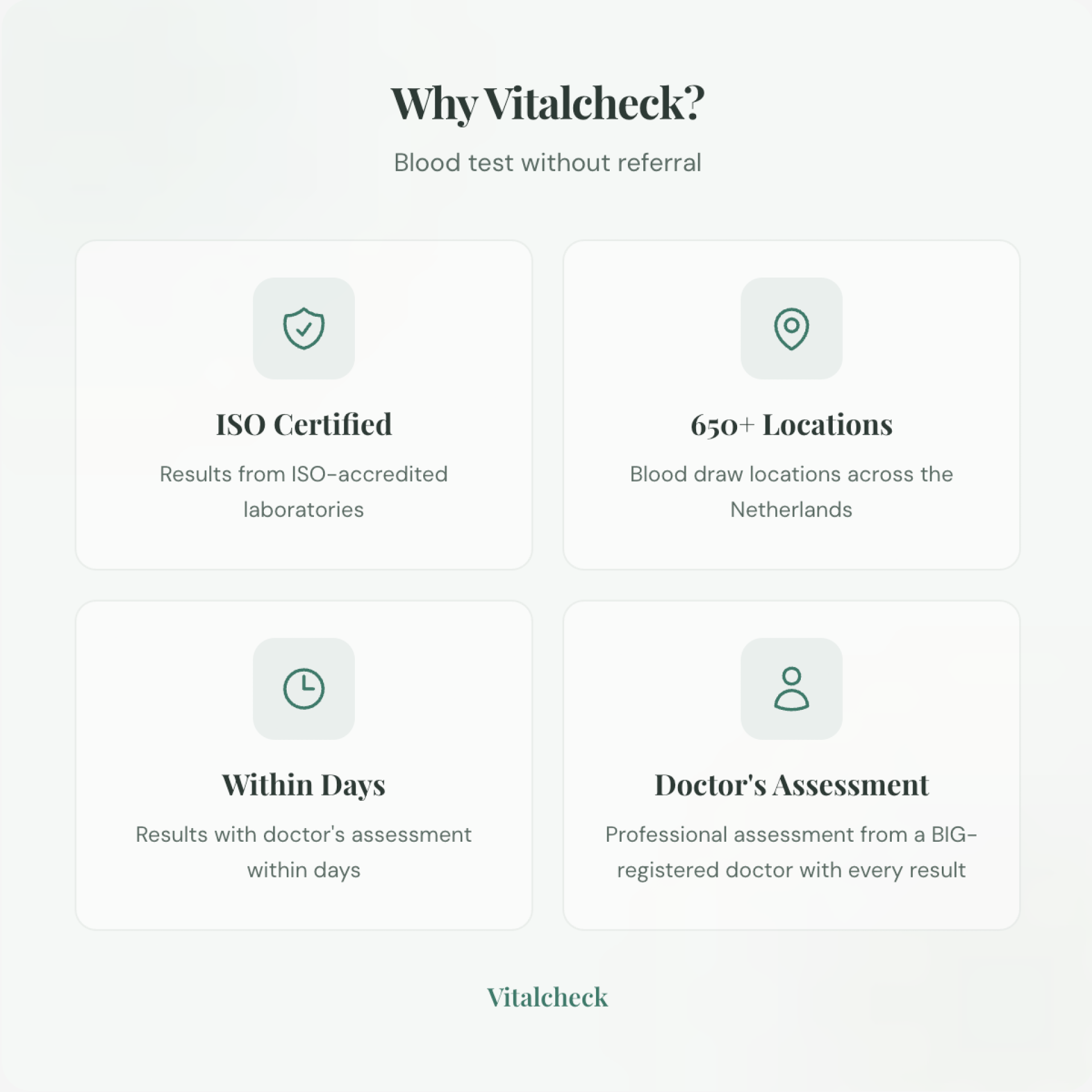
You order online, need no referral and have your blood drawn at one of our 700+ certified sample points. All eight values come from a single draw and are ready within a few working days, reviewed by a BIG-registered doctor.
Why this test?
A four-value screen tells you whether the clotting chain is slowed and at which end. This panel starts where that screen stops. It adds four measurements that each look at the same chain from a different angle, so a single draw leaves you with more than just a direction to search in.
Prothrombin time (PT) measures the same laboratory reaction as the INR, but reports it in seconds rather than as a ratio. A laboratory report puts the two side by side, which is why you see both here. Thrombin time isolates the final step of the chain: the conversion of fibrinogen into fibrin. D-dimer measures something different again, namely the fragments left behind when the body breaks a clot down. And antithrombin III is the body's own brake on clotting, the protein that keeps the chain from running on further than it should.
This tier is for people who would rather get all eight values out of one appointment than come back for a second. If you only want to know whether the basics are in order, the four-value coagulation panel covers that.
Who is this test for?
This extended coagulation panel may suit:
- people for whom bruising or prolonged bleeding has become more frequent than it used to be
- people whose doctor asked for clotting values and who would rather not wait for a referral
- people in whose family a bleeding or clotting disorder has been diagnosed
- people with liver disease, since the liver makes the proteins this panel measures
- people with clots in the family who want to see where their values sit before starting oestrogen-containing contraception or a pregnancy
- people already being investigated who want concrete numbers to bring into a consultation
There is one group this panel is not for, and that exclusion holds as firmly as the rest of the list. Do not order it within roughly three months of a clot, or while you are taking anticoagulants. Antithrombin III is consumed while a clot forms and is lowered by heparin, and D-dimer stays raised throughout that period. The result would not be readable. And if you take anticoagulants and want your INR checked so your dose can be adjusted, that monitoring stays with your anticoagulation clinic.
What is tested?
You get eight values, spread across the whole chain:
- INR: the standardised result of the clotting route that starts outside the vessel, which is what makes labs comparable with each other.
- PT (prothrombin time): the same reaction, reported in seconds instead of as a ratio.
- aPTT: how long the route that starts inside the vessel takes to complete.
- Thrombin time (TT): the final step measured on its own, fibrinogen turning into fibrin.
- Fibrinogen: how much raw material is available for the conversion the thrombin time measures.
- Platelets: how many platelets are available to make that first plug with.
- D-dimer: the fragments released when a clot is broken down again.
- Antithrombin III (activity): how well the natural brake on clotting is working.
Seeing both INR and PT on that list is not duplication. They come from one and the same laboratory reaction: the lab times the clot in seconds and converts that figure into the INR. A laboratory report gives the two together as a matter of routine, and so do we.
All eight sit in the Coagulation category, where each value is explained in more depth.
What can this test tell you?
The four screening values show whether the chain is slowed and at which end. The four additions fill in points the screen leaves open.
A normal D-dimer makes it unlikely that a clot formed recently. Ruling out is what the assay is good at, though a normal result lowers the likelihood rather than excluding a clot outright; how much weight it carries depends on the clinical suspicion. In the other direction it works far less well. A raised D-dimer has many possible causes and means little by itself; how likely a clot actually is remains a clinical judgement, made by a doctor from your symptoms and your situation rather than from the number.
A low antithrombin III can be inherited, but far more often it is acquired: through liver disease, protein lost through the kidneys, a recent clot, or treatment with heparin. One low reading is therefore not a conclusion. What it means depends on what else is going on, which is exactly what a doctor weighs alongside it.
No single value in this panel establishes a clotting disorder on its own. What the panel does is sharpen the question and give a doctor a starting point for whatever may be needed next.
How is the sample collected?
The sample is a venous draw, taken at one of our 700+ certified sample points across the Netherlands. Which location, and which slot, is yours to choose once the order is in.
All eight values come from that same draw, so the four extra measurements do not mean a second visit.
Coagulation assays are collected into a citrate tube that has to be filled exactly to the mark and reach the lab quickly, or the results drift. That is why trained staff take the sample at a certified location, rather than you taking it at home.
When is this test useful?
This extended panel can be useful:
- when an earlier coagulation screen showed something and you want more values before a follow-up consultation
- when clots run in your family and you want to see where your values sit before starting oestrogen-containing contraception or a pregnancy
- ahead of a planned procedure where a clinic or dentist has asked for a wider set of clotting values
- while monitoring known liver disease, since the liver makes both the clotting factors and antithrombin III
- but not within roughly three months of a clot, and not while you are on anticoagulants: wait until treatment is far enough behind you, because until then the values cannot be read
What do the results mean?
Each value is shown next to the reference range of the laboratory that analysed your blood. That weighs more heavily for coagulation assays than for many other tests: the result depends on the reagent and the analyser used, so ranges differ from lab to lab. The same thrombin time can land mid-range at one lab and just above the range at another.
D-dimer carries one extra caveat. The value climbs with age and rises with pregnancy, infection, recent surgery, inflammation and cancer. In someone with no symptoms, a raised D-dimer is therefore usually traceable to one of those, and not to a clot.
A value outside the range is not a diagnosis. It means this measurement differs from what the lab sees in most people. Mild deviations in a single value are found regularly in people who have never had a bleed or a clot.
Preparation
You do not need to fast. Eat and drink as normal, and book your appointment for whatever time suits you.
Timing does matter here. Only have this panel done once you are at least three months clear of a clot and off anticoagulants. Antithrombin III is consumed while a clot forms and is lowered by heparin, and D-dimer stays raised through that period, so the protein-pathway values cannot be read.
Also make a note of an infection or flu you are in the middle of, a pregnancy, and any high-dose supplements you take. All three can shift your values, so mention them when the result is reviewed.
What happens after the results?
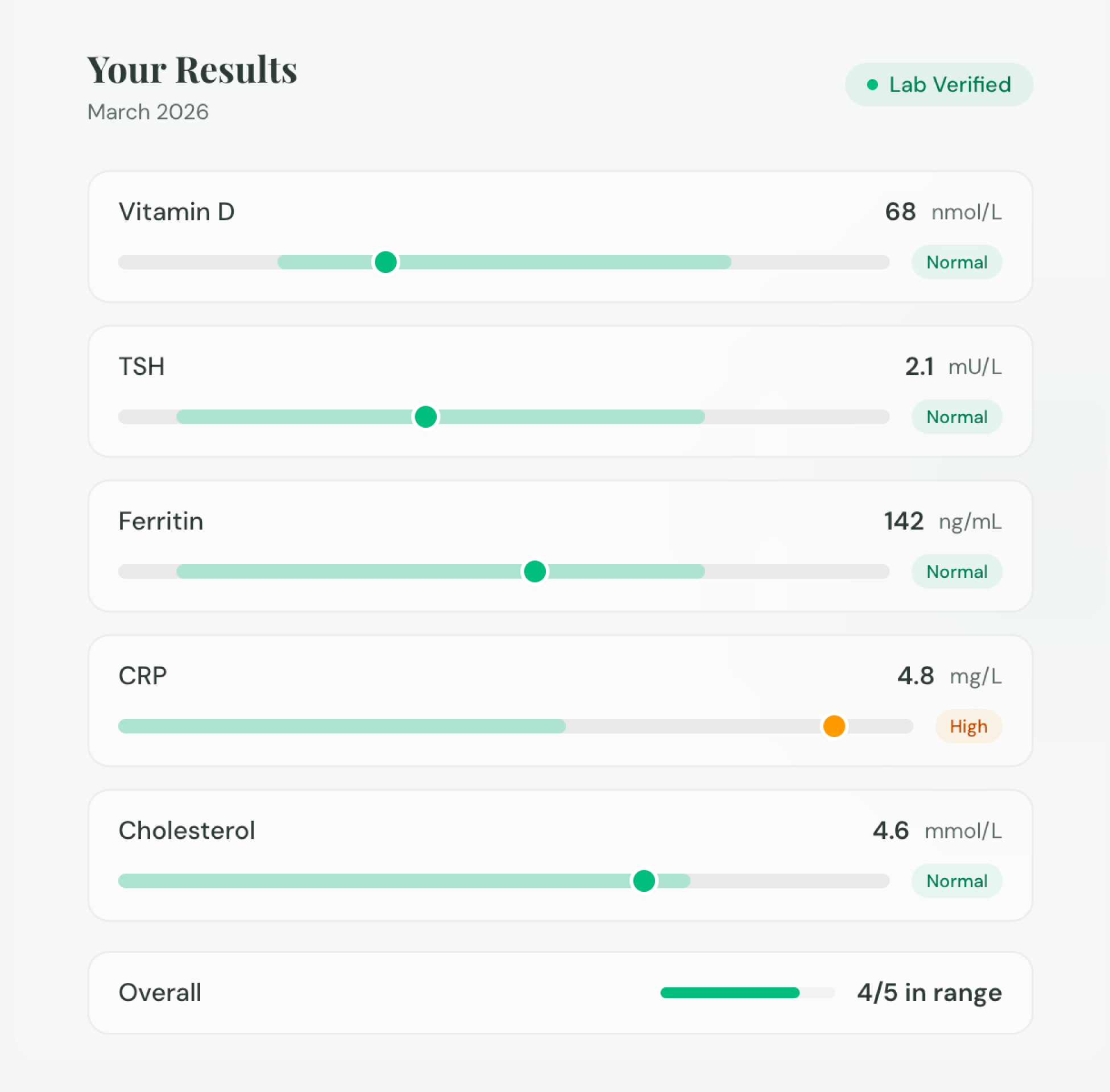
Your results are online within a few working days, with your own measurement shown next to the lab reference range for each value and a plain-language explanation. Every result includes a professional assessment from a BIG-registered doctor.
If all eight values sit inside the range, that is a quiet baseline for those eight measurements. Inherited clotting variants such as factor V Leiden are not among them, so do not let a decision about oestrogen-containing contraception or a pregnancy rest on this result alone; take it to your GP first. The FAQ below sets out what a thrombophilia workup adds. If antithrombin III is abnormal or D-dimer is raised, book an appointment with your GP rather than repeating the measurement yourself. Your GP can weigh the values against your symptoms, your medication and your history, and decide whether follow-up testing makes sense and which.
Frequently Asked Questions
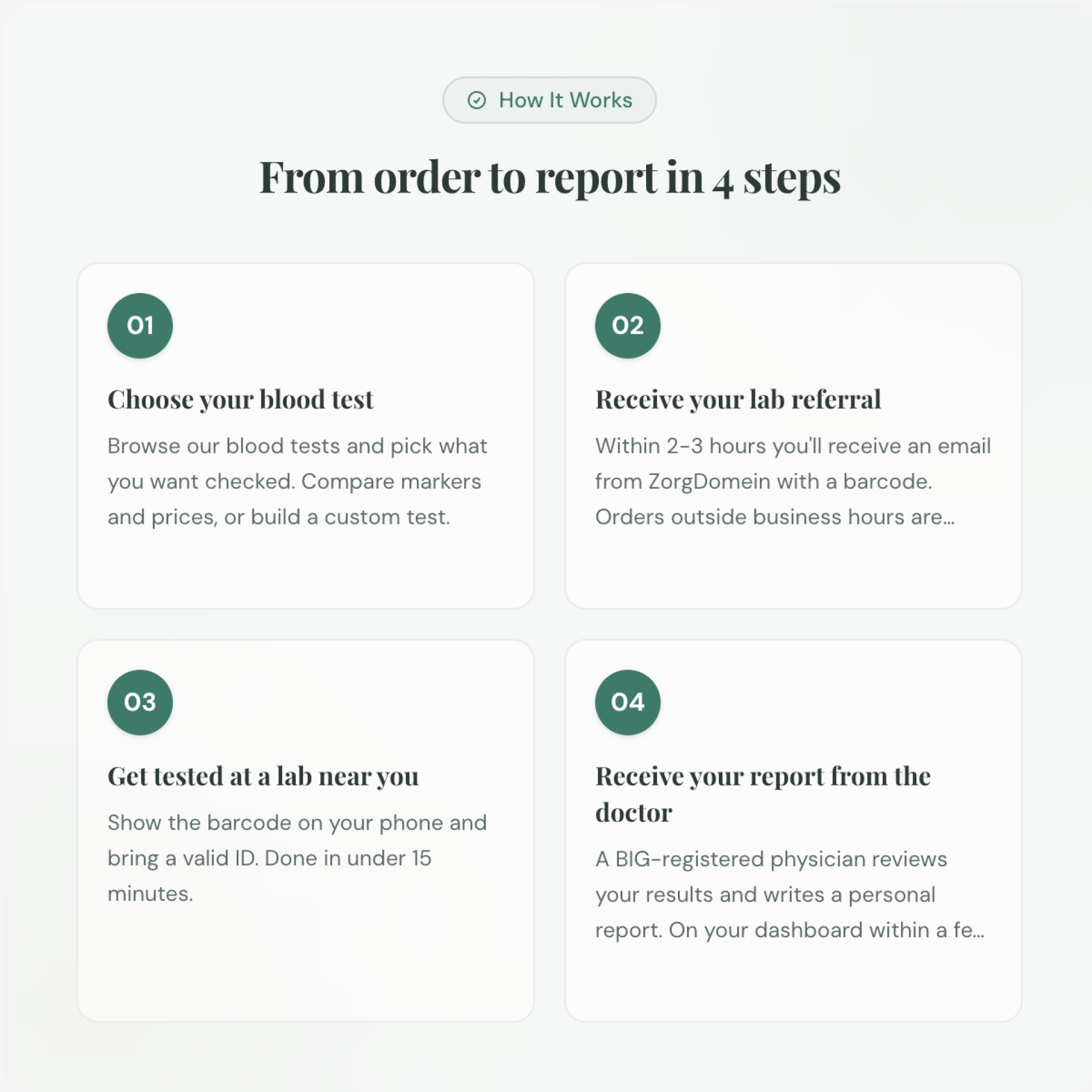
From order to report in 4 steps
A blood test without referral means no waiting. Just order and go.
Choose your blood test
Browse our blood tests and pick what you want checked. Compare markers and prices, or build a custom test.
Receive your lab referral
On the same business day you'll receive an email from ZorgDomein with a barcode. Orders outside business hours are processed the next business day.
Get tested at a lab near you
Show the barcode on your phone and bring a valid ID. Done in under 15 minutes.
Receive your report from the doctor
A BIG-registered physician reviews your results and writes a personal report. On your dashboard within a few business days.
Choose your blood test
Browse our blood tests and pick what you want checked. Compare markers and prices, or build a custom test.
Receive your lab referral
On the same business day you'll receive an email from ZorgDomein with a barcode. Orders outside business hours are processed the next business day.
Get tested at a lab near you
Show the barcode on your phone and bring a valid ID. Done in under 15 minutes.
Receive your report from the doctor
A BIG-registered physician reviews your results and writes a personal report. On your dashboard within a few business days.
Always a location near you
With 700+ certified phlebotomy points across the Netherlands.
What We Test
This health panel includes 8 biomarkers to give you a comprehensive picture of your health.
A platelet (thrombocyte) count measures the number of platelets in your blood. Platelets are small cell fragments essential for blood clotting, helping to stop bleeding when blood vessels are injured.
Learn moreAntithrombin III Activity measures the functional activity of antithrombin, a key natural anticoagulant protein that inhibits several clotting factors including thrombin and factor Xa. Reduced antithrombin activity increases the risk of blood clot formation (thrombosis). Both inherited and acquired forms of antithrombin deficiency exist.
Learn moreaPTT (Activated Partial Thromboplastin Time) measures how long it takes blood to form a clot through the intrinsic and common coagulation pathways. It is one of the most commonly ordered coagulation tests and is used to screen for clotting factor deficiencies, monitor heparin therapy, and evaluate bleeding disorders.
Learn moreD-Dimer is a fibrin degradation product released when blood clots are broken down. Elevated D-Dimer indicates that clot formation and breakdown (fibrinolysis) is occurring, but it is not specific to any particular condition. It is most commonly used to help rule out venous thromboembolism (DVT/PE).
Learn moreFibrinogen is a protein produced by the liver that plays a dual role as both a clotting factor and an acute-phase reactant. It is converted to fibrin by thrombin to form blood clots, and its levels rise during inflammation, infection, and tissue damage.
Learn moreINR (International Normalized Ratio) standardises prothrombin time results across laboratories, making it the universal measurement for monitoring oral anticoagulant therapy (warfarin) and assessing the extrinsic clotting pathway. It is also used to evaluate liver synthetic function.
Learn morePT (Prothrombin Time) measures how long it takes blood to form a clot through the extrinsic and common coagulation pathways. It evaluates factors VII, X, V, II, and fibrinogen. PT is commonly reported alongside INR.
Learn moreThrombin Time (TT) measures how long it takes fibrinogen to convert to fibrin — the final step of the clotting cascade. It specifically evaluates fibrinogen function and detects the presence of thrombin inhibitors such as heparin.
Learn morePlatelets (Thrombocytes)
HematologyA platelet (thrombocyte) count measures the number of platelets in your blood. Platelets are small cell fragments essential for blood clotting, helping to stop bleeding when blood vessels are injured.
A low platelet count (thrombocytopenia) means bleeding is stopped less effectively. You notice it as bruises that form easily, small wounds that keep bleeding, bleeding gums or nosebleeds. Causes range from a viral infection and medication to an autoimmune reaction, a liver condition or an enlarged spleen. A high count (thrombocytosis) is usually reactive: the body temporarily produces more platelets during inflammation, infection, iron deficiency or after surgery. Less often a bone marrow disorder underlies it. With strongly raised counts the risk of clot formation can increase. The count says nothing about how well the platelets work. Anti-inflammatories such as aspirin and NSAIDs inhibit platelet function while the count stays normal.
Antithrombin III (Activity)
CoagulationAntithrombin III Activity measures the functional activity of antithrombin, a key natural anticoagulant protein that inhibits several clotting factors including thrombin and factor Xa. Reduced antithrombin activity increases the risk of blood clot formation (thrombosis). Both inherited and acquired forms of antithrombin deficiency exist.
Antithrombin deficiency is the strongest inherited thrombophilia risk factor. Identifying low activity helps guide decisions about anticoagulation during high-risk situations such as surgery, pregnancy, or prolonged immobility.
aPTT
CoagulationaPTT (Activated Partial Thromboplastin Time) measures how long it takes blood to form a clot through the intrinsic and common coagulation pathways. It is one of the most commonly ordered coagulation tests and is used to screen for clotting factor deficiencies, monitor heparin therapy, and evaluate bleeding disorders.
aPTT helps identify bleeding disorders, monitor anticoagulant therapy, and detect clotting inhibitors. It evaluates factors XII, XI, IX, VIII, X, V, II (prothrombin), and fibrinogen.
D-Dimer
CoagulationD-Dimer is a fibrin degradation product released when blood clots are broken down. Elevated D-Dimer indicates that clot formation and breakdown (fibrinolysis) is occurring, but it is not specific to any particular condition. It is most commonly used to help rule out venous thromboembolism (DVT/PE).
A negative D-Dimer result is very useful for ruling out DVT and PE in patients with low-to-moderate clinical probability. However, D-Dimer can be elevated by many conditions and naturally rises with age.
Fibrinogen
CoagulationFibrinogen is a protein produced by the liver that plays a dual role as both a clotting factor and an acute-phase reactant. It is converted to fibrin by thrombin to form blood clots, and its levels rise during inflammation, infection, and tissue damage.
Low fibrinogen can cause bleeding problems, while elevated fibrinogen is associated with increased cardiovascular risk and may reflect chronic inflammation.
INR
CoagulationINR (International Normalized Ratio) standardises prothrombin time results across laboratories, making it the universal measurement for monitoring oral anticoagulant therapy (warfarin) and assessing the extrinsic clotting pathway. It is also used to evaluate liver synthetic function.
INR monitoring ensures anticoagulant therapy remains in the therapeutic range — high enough to prevent clots but not so high as to cause bleeding. INR also reflects liver function since the liver produces most clotting factors.
PT (Prothrombin Time)
CoagulationPT (Prothrombin Time) measures how long it takes blood to form a clot through the extrinsic and common coagulation pathways. It evaluates factors VII, X, V, II, and fibrinogen. PT is commonly reported alongside INR.
PT/INR is essential for warfarin monitoring, liver function assessment, and screening for clotting factor deficiencies.
Thrombin Time
CoagulationThrombin Time (TT) measures how long it takes fibrinogen to convert to fibrin — the final step of the clotting cascade. It specifically evaluates fibrinogen function and detects the presence of thrombin inhibitors such as heparin.
TT helps identify fibrinogen abnormalities (dysfibrinogenaemia), detect heparin contamination, and evaluate unexplained prolongation of PT or aPTT.
Related biomarkers
Biomarkers often explored alongside this test for a fuller picture.
Antithrombin III (Concentration)
Antithrombin III Concentration complements the activity test for comprehensive thrombophilia screening, classifying any deficiency to guide preventive care.
Basic Blood Count
A basic blood count measures three core values in your blood: hemoglobin, white blood cells and platelets. Together they say something about oxygen transport, immune defence and clotting. It is a simple baseline check, without the red-cell indices and white-cell differential of a complete blood count.
Basophils
Basophils are the least common white blood cells and play a role in allergic and inflammatory responses, partly by releasing histamine. They are part of your complete blood count and are normally present in small numbers. A raised count is uncommon and is reviewed together with your other values.
Blood Type + Rh
A blood type test determines your ABO blood group and Rh factor. Knowing your blood type is essential for safe blood transfusions, organ transplants, and pregnancy planning.
Complete Blood Count (CBC)
The complete blood count is the foundation of any comprehensive health assessment. By evaluating all major blood components at once, a CBC gives you reassuring insight into your immune function, oxygen-carrying capacity, and overall blood health — all in one test.
Coombs Test (Indirect)
The indirect Coombs test screens for unexpected antibodies in your blood that may react against red blood cells. It is an important test for transfusion safety and prenatal care.
Related Health Panels
Discover more panels for a comprehensive health picture.
Ferritin Test
Measure your ferritin, your body's iron store and a common cause of fatigue. No referral needed.
Vitamin D Test
Measure your vitamin D, important for your bones, muscles and immune system. No referral needed, results within a few working days.
Coagulation Panel
Measures your INR, aPTT, fibrinogen and platelets in one draw: the four values a doctor uses to judge how quickly your blood clots.
This test not quite right?
Build your own blood test from 252+ individual biomarkers — choose exactly what you need.
Have a question?
Our team is happy to help. Ask your question and we'll respond as soon as possible.