Vitamin D test: your 25-OH level from the lab
Measure your vitamin D, important for your bones, muscles and immune system. No referral needed, results usually within 2 working days of the blood draw.
Add to your order
No referral needed
Added to your order
Click the button to view your cart
Included Markers
1 markersVitamin D (25-OH)
Little time outdoors, long working days, and a dark winter: it makes a vitamin D shortfall surprisingly common. Vitamin D supports your bones, muscles, and immune system, and your body mainly makes it from sunlight. A vitamin D test measures how much is in your blood, so you do not have to guess.
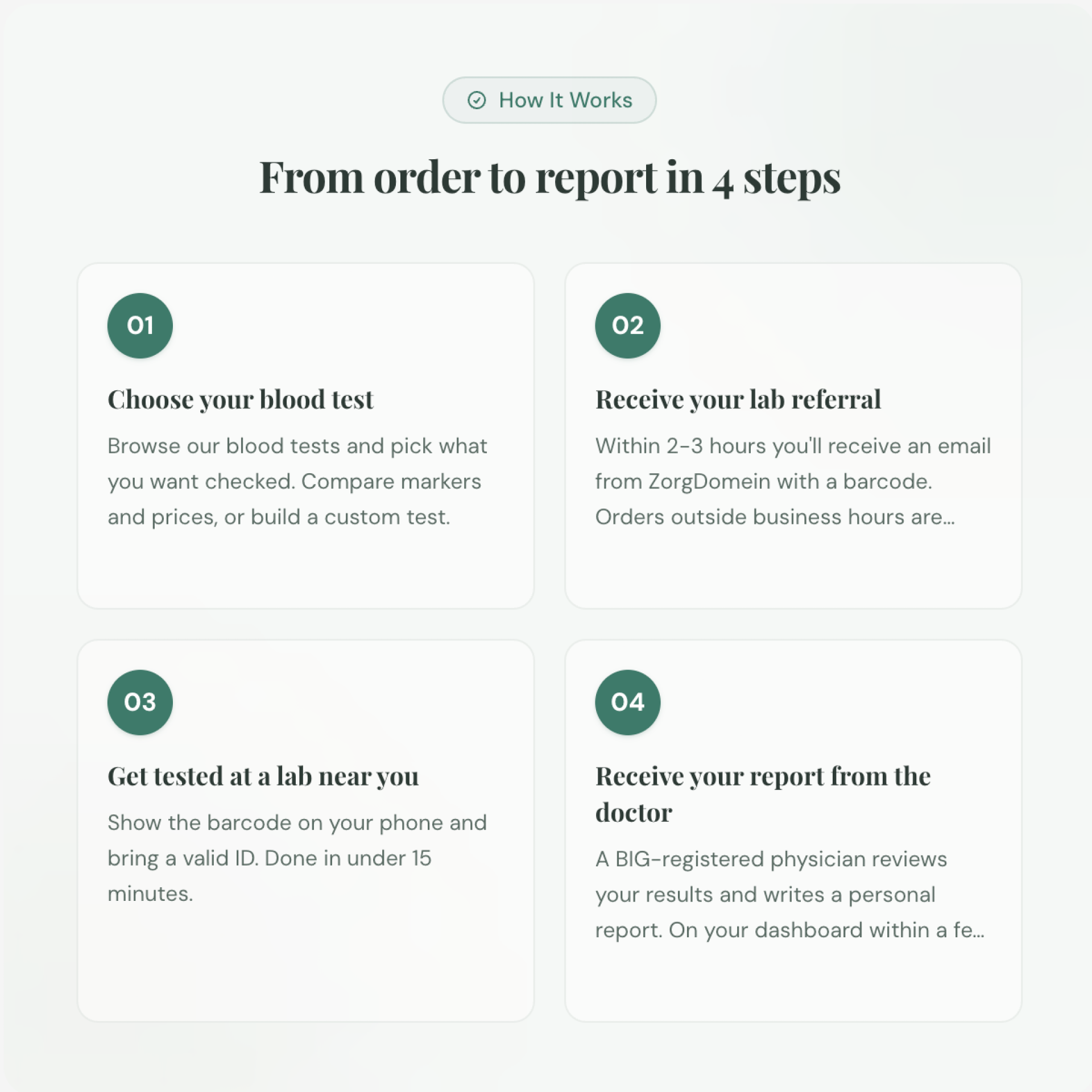
You order the test online and choose a sample point near you. Your results are usually in your Vitalcheck account within 2 working days of the blood draw, often the next day. Some markers take longer. Every result is reviewed by a BIG-registered doctor, and no referral from your GP is needed.
Why this test?
Your body makes most of its vitamin D from sunlight on your skin. If busy days keep you indoors, your level can drift down over winter without you noticing.
A vitamin D3 deficiency is therefore common, even in people who are otherwise healthy. This test gives you a concrete data point, a starting point for a conversation with your doctor rather than guesswork.
Vitamin D helps your body absorb calcium and phosphate from your food. Those two minerals keep your bones and teeth strong. Without enough vitamin D your gut takes up less of them.
Who is this test for?
This test can be of interest if you:
- work mostly indoors and see little daylight
- feel low on energy or more prone to bugs in winter
- have darker skin or usually keep your skin covered
- want to support your bones, muscles, or general resilience with the right data
Even if you simply want to know where you stand, a measurement can offer peace of mind.
What is tested?
This test measures a single blood value:
- 25-OH vitamin D: the stored form of vitamin D that best reflects how much you have in reserve. To learn more about this value, read our explanation of vitamin D (25-OH).
This 25-OH measurement gives a more reliable read on your stores than a single snapshot. That is because this form stays in your blood longer.
What can this test tell you?
The result can show whether your vitamin D is on the low or high side. A deficiency is often linked to fatigue, weaker bones, and reduced muscle strength, though this varies from person to person.
On the other hand, too much vitamin D, usually from high-dose supplements, can also play a role. The doctor reviews your value and places it in context.
How is the sample collected?
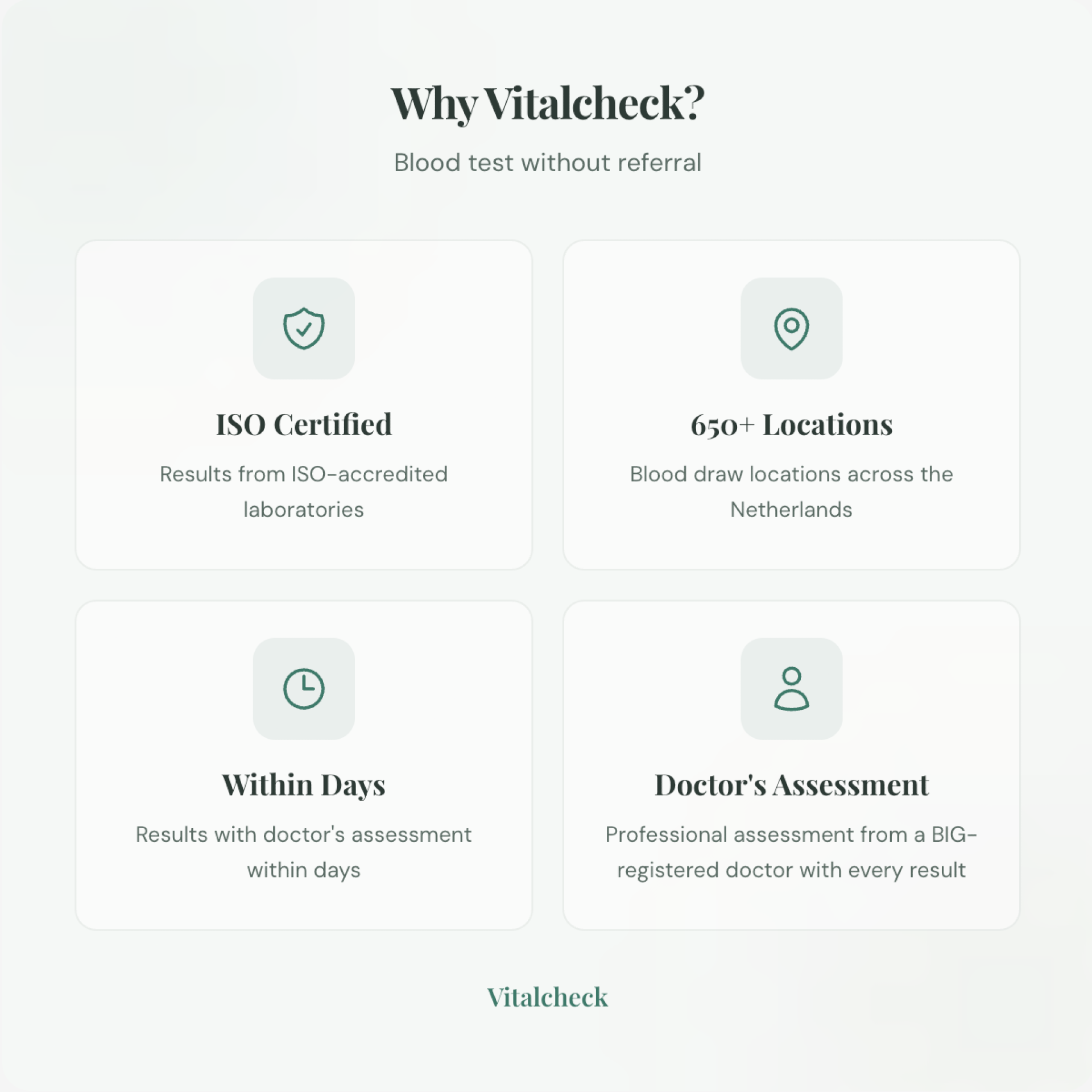
For this test, blood is drawn at a certified sample point. There are 650+ locations across the Netherlands, so you can often choose one close to home or work.
After ordering online, you pick a sample point and a time that suits you. The blood is drawn by trained staff.
When is this test useful?
You might consider this test when:
- you want to know where you stand at the end of winter
- you are considering supplements and want a baseline first
- you already take supplements and want to track whether your value responds
- you have symptoms such as ongoing fatigue and want to help rule this out
Vitamin D does not depend on a fixed time of day, so you can choose a moment that suits you.
What do the results mean?
Your result shows your vitamin D level in nmol/l, alongside a reference range. In the Netherlands the Health Council, the NHG and the national prescribing standard all use the same target values. The threshold depends on your age.
| Age | Value in nmol/l | Assessment |
|---|---|---|
| Under 70 | Below 30 | Deficient |
| Under 70 | 30 or above | Sufficient |
| 70 and over | Below 35 | Severely deficient |
| 70 and over | 35 to 50 | Deficient |
| 70 and over | 50 or above | Sufficient |
A value of exactly 30.0 nmol/l counts as sufficient, not deficient. If you have just turned 70, your value is read against the lower block.
Some tests from abroad report in ng/ml instead of nmol/l. One nmol/l equals 0.40 ng/ml. So never compare two numbers without checking the unit first.
These are target values, not a diagnosis. A low value can fit with a vitamin D deficiency, but on its own it does not say what caused it. A high value usually comes from high-dose supplements. A BIG-registered doctor reads your vitamin D levels and puts them in context.
Preparation
For a vitamin D measurement you usually do not need to fast. If you take supplements containing vitamin D, it helps to mention that with your result, as it affects your value.
Beyond that, there is little to prepare: you choose a sample point and a moment that fits your schedule.
What happens after the results?
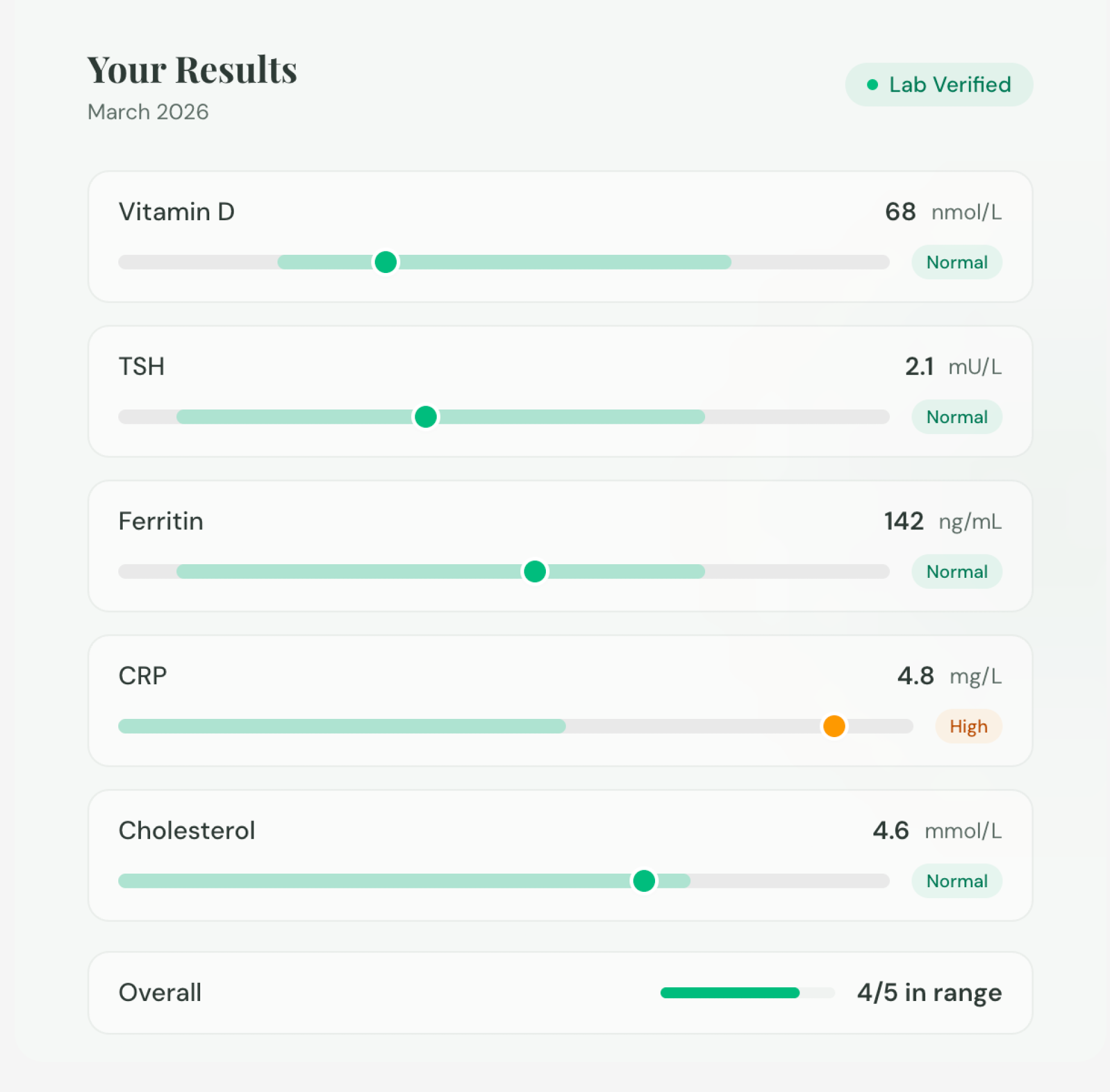
Your results are usually in your Vitalcheck account within 2 working days of the blood draw, often the next day. Some markers take longer. It carries your value, a reference range, and a clear explanation, so you can see where you stand.
Every blood test result includes a professional assessment from a BIG-registered doctor. For treatment decisions, discuss your results with your GP.
Self-test or a blood test in the lab?
Pharmacies and online shops sell vitamin D self-tests that use a finger prick. Such a test usually gives a colour reading: low, sufficient or high. For a rough impression that can be enough.
A blood test in the lab works differently. You get a number in nmol/l, not a colour. That lets you measure again later and put the two results side by side.
If you already take a vitamin D supplement, that difference is practical. A colour card does not show whether your value rose by 10 or by 40 nmol/l. A number does.
Where do you find vitamin D?
Your body makes most of its vitamin D itself, under the influence of sunlight. Food supplies a smaller share.
The best known source is oily fish, such as salmon, herring and mackerel. Egg yolk also contains vitamin D3. In the Netherlands it is added to margarine and low-fat spreads.
If you eat little fish, or eat vegetarian or vegan, that supply is limited. Extra vitamin D from a supplement is then an option. The Health Council advises a daily supplement for several groups. These include young children, pregnant women, people with darker skin and older adults.
With a bowel condition such as coeliac disease, an autoimmune disorder, your body often absorbs vitamin D less well. A measurement then shows what is left of that supply.
How much vitamin D you need differs by age and situation. The Health Council publishes dietary reference values for this. A measurement shows where you stand yourself.
Frequently Asked Questions
No, for a vitamin D measurement you usually do not need to fast. If you take supplements, mention that with your result, as it affects your value.
Your body mainly makes vitamin D from sunlight. In winter there is less sun and you often spend less time outdoors, so your value can drop.
An excess usually comes from high-dose supplements and can play a role. The doctor assesses your result and discusses any next steps.
Yes, finger-prick self-tests exist that give a colour reading. A blood test in the lab gives a number in nmol/l instead. That lets you measure again later and compare the two results.
This test costs €70,-, with the blood draw included. No draw fee follows; you pay it yourself.
No. After you order we take care of a referral through ZorgDomein within one business day; for orders after 17:00 or at the weekend the next business day applies. The ZorgDomein email contains a barcode, which you show at the draw site. At a few draw sites you set a time on your order page, or we schedule it.
No. Testing on your own initiative falls outside the basic Dutch insurance. You pay it yourself rather than through your insurer, and it does not count towards your deductible (eigen risico).
Allow one business day: by then the referral email is in, and you cannot be drawn earlier. Some draw sites then hold a walk-in session; the others work by appointment. This is listed per location.
The barcode from the ZorgDomein email and a valid ID. Showing the barcode on your phone is enough; no need to print. Without a BSN the email carries no barcode, and you print the referral form from the link in that same email.
Yes, take it as usual, unless your own doctor indicated otherwise. Some markers require more, such as no alcohol for 24 hours or no heavy exertion for 48 hours. That is stated on the test and in the instructions with your order.
At the draw site you show the barcode and a valid ID, after which the blood is taken. The draw takes about a quarter of an hour.
Yes. A BIG-registered doctor assesses every result and explains your values in your account. For any treatment, discuss the result with your own GP.
Vitalcheck works with a network of independent, certified laboratories throughout the Netherlands. These laboratories also manage the draw sites, which do not belong to Vitalcheck. Reference values can differ somewhat between laboratories.
No. The test does not go through your GP and is not recorded in your medical file. Data goes to a healthcare provider only with your written consent and is never sold. Anonymous testing is not possible: a valid result requires your name, date of birth and a valid ID.
What We Test
| No. | Biomarker | Unit |
|---|---|---|
| 01 | Vitamin D (25-OH) | nmol/l |
| Your results are usually in your Vitalcheck account within 2 working days of the blood draw. The laboratory states a longer turnaround for Vitamin D (25-OH). | ||
Preparation
Nothing special is needed for these tests.
- Water is always fine. Drink as usual beforehand, it makes the draw easier.
- Take your usual medication, unless your own doctor told you otherwise.
Extend this panel
Same draw, no second appointment.
Related Health Panels
Fatigue
Investigate some common causes of fatigue: CBC, thyroid, iron, vitamins, glucose, and HbA1c.
Celiac Disease
Anti-TTG and Endomysium IgA: a commonly used celiac disease screening.
B Vitamins
Vitamin blood test: B12, folate, B1 and B6 in one draw.