Coagulation panel: how quickly your blood clots
Measures your INR, aPTT, fibrinogen and platelets in one draw: the four values a doctor uses to judge how quickly your blood clots.
Important to know
If you take anticoagulants and want your INR checked to adjust your dose, stay with your anticoagulation clinic. They monitor your value on a fixed schedule and adjust your dose directly; we do not. This panel is for people who want to know how their blood clots, for example with easy bruising, prolonged bleeding after a cut, or at a doctor's request.
Add to your order
No referral needed
Added to your order
Click the button to view your cart
Included Markers
4 markersINR, Platelets (Thrombocytes), Fibrinogen, aPTT
Clotting is teamwork. Platelets seal the damaged vessel first, then clotting factors weave a fibrin mesh over that plug to hold it in place. This coagulation panel measures both halves of that chain in a single blood draw: INR, aPTT, fibrinogen and platelets.
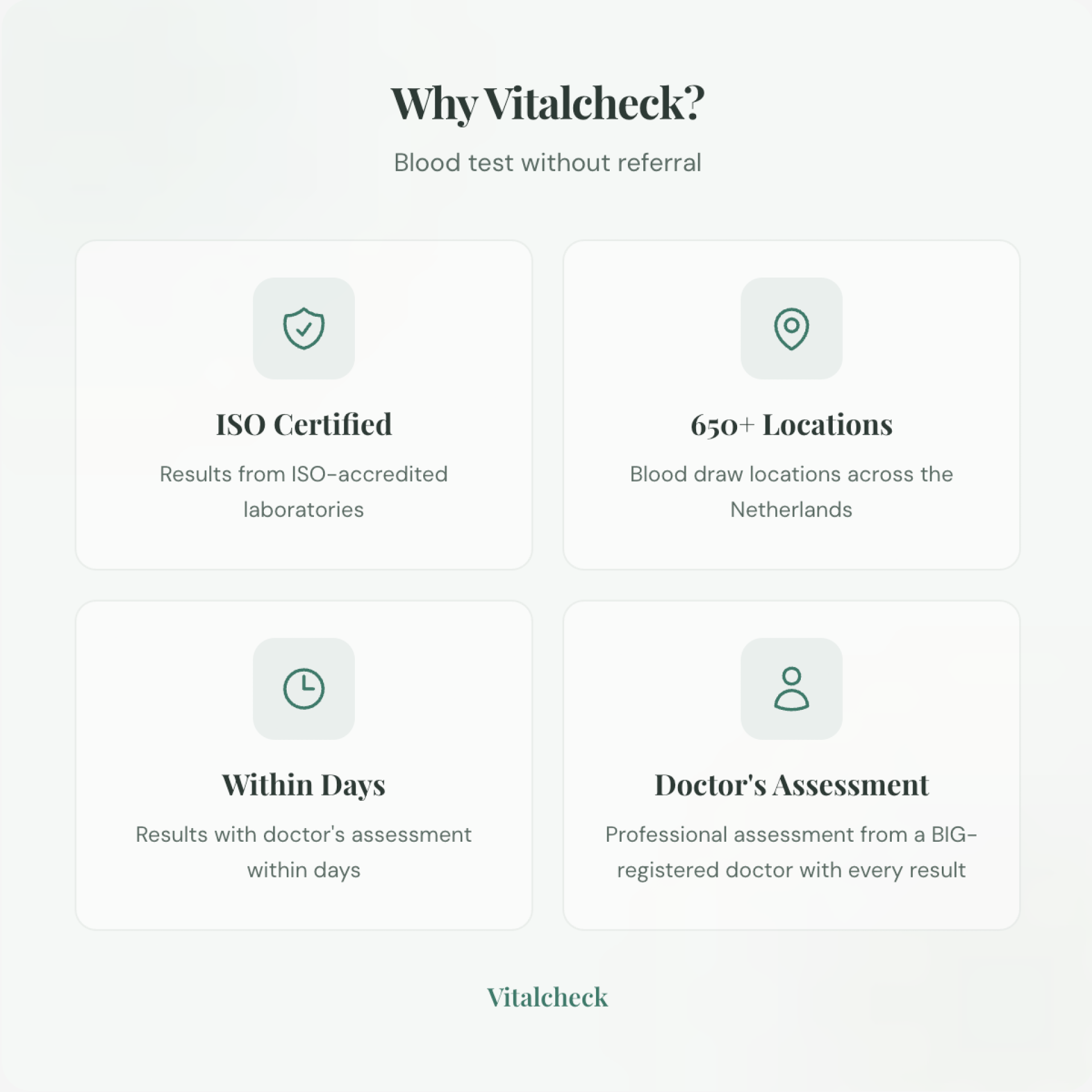
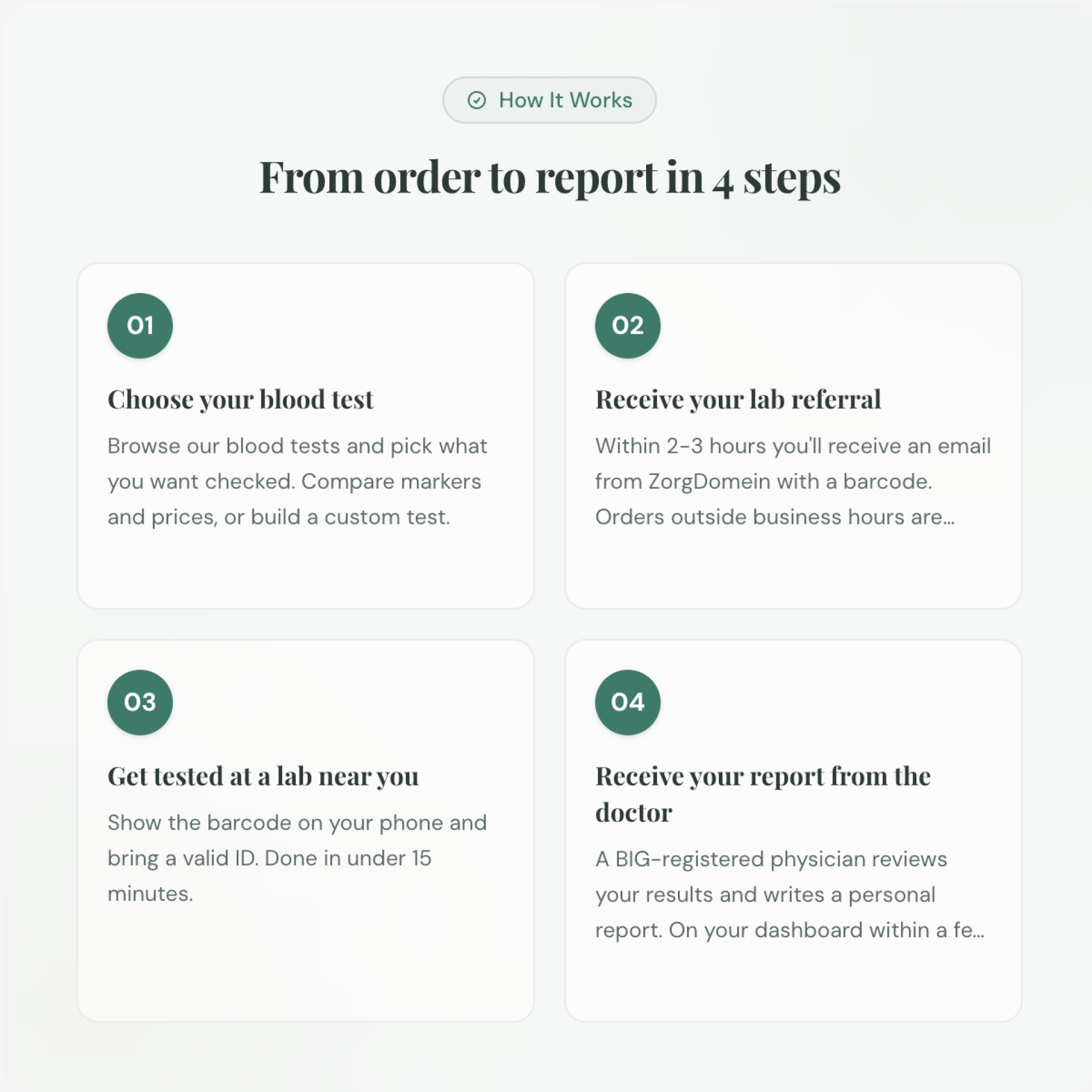
You order online, need no referral and have your blood drawn at one of our 700+ certified sample points. Your results are ready within a few working days, reviewed by a BIG-registered doctor.
Why this test?
Blood clots in two steps. The moment a vessel wall is damaged, platelets stick to it and form a first plug within seconds. A cascade of clotting factors then builds a firm fibrin mesh over that plug, so the wound stays closed instead of reopening. When either step runs less smoothly, you usually notice it in ordinary ways.
Bruises turn up without you remembering the knock. Nosebleeds come back more often than they used to. A shaving nick keeps oozing long after it should have stopped. Periods feel heavier than you think they ought to. A coagulation screen looks at both halves of the chain at once, so you are not left guessing which end the problem sits at.
Worth knowing up front: a value just outside the reference range is common, and the explanation is usually mundane. An infection you were getting over, or a difference between laboratories, can be enough on its own. An abnormal result is a reason to have a conversation, not a reason to worry.
Who is this test for?
This coagulation panel may suit:
- people who bruise more easily, or bleed for longer, than they think they should
- people whose doctor asked for a coagulation screen and who want it done without a referral
- people with a family member who has a known bleeding or clotting disorder
- people with liver disease, since the liver makes almost all of the clotting factors
If you take anticoagulants and want your INR checked so your dose can be adjusted, this is not the panel for you. That monitoring belongs with your anticoagulation clinic, which tracks your value on a fixed schedule and changes your dose directly.
What is tested?
You get four values, two for each half of the clotting chain:
- INR: a standardised measure of how quickly the clotting route that starts outside the vessel completes. That standardisation is what makes results from different labs comparable.
- aPTT: covers the route that starts inside the vessel, and times how long it takes.
- Fibrinogen: the protein the fibrin mesh is built from, the raw material for the layer that sets over the plug.
- Platelets: the cells that form the very first plug.
All four sit in the Coagulation category, where each value is explained in more depth.
What can this test tell you?
A prolonged INR or aPTT points to a clotting factor being low, or to something in the blood slowing the chain down. Which of the two is prolonged narrows down where: INR stands for the route that begins outside the vessel, aPTT for the route that begins inside it. If both are prolonged, the cause is more likely to sit in the stretch the two routes share.
A low fibrinogen or a low platelet count points to the other end of the chain: less raw material to build the mesh with, or fewer platelets to form the first plug.
What this screen does is make the question smaller. It tells you which direction is worth looking in, not what you have. Which follow-up test comes next is a decision a doctor makes, based on your results and your symptoms.
How is the sample collected?
For this panel, blood is drawn from a vein at one of our 700+ certified sample points across the Netherlands. After ordering you pick the location and the time yourself.
Coagulation tests need a citrate tube that has to be filled to the mark and reach the lab quickly, or the values drift. That is why the draw is done by trained staff at a certified location, and not at home.
When is this test useful?
A coagulation panel can be useful:
- ahead of a planned procedure where a clinic or dentist has asked for clotting values
- when bleeding symptoms have been going on for a while and you want to walk into a consultation with something concrete
- while monitoring known liver disease, since the liver makes the clotting factors
- when a family member has a diagnosed bleeding disorder and you want to see where your own values sit
What do the results mean?
Each value is shown next to the reference range of the laboratory that analysed your blood. That matters more here than it does for many other assays: the result depends on the reagent and the analyser used, so ranges differ from lab to lab. The same aPTT can land mid-range at one lab and just above the range at another.
A value outside the range is not a diagnosis. It means this measurement differs from what the lab sees in most people, and nothing more than that. Mild deviations in a single value are found regularly in people who have never had a bleed worth noticing.
What happens after the results?
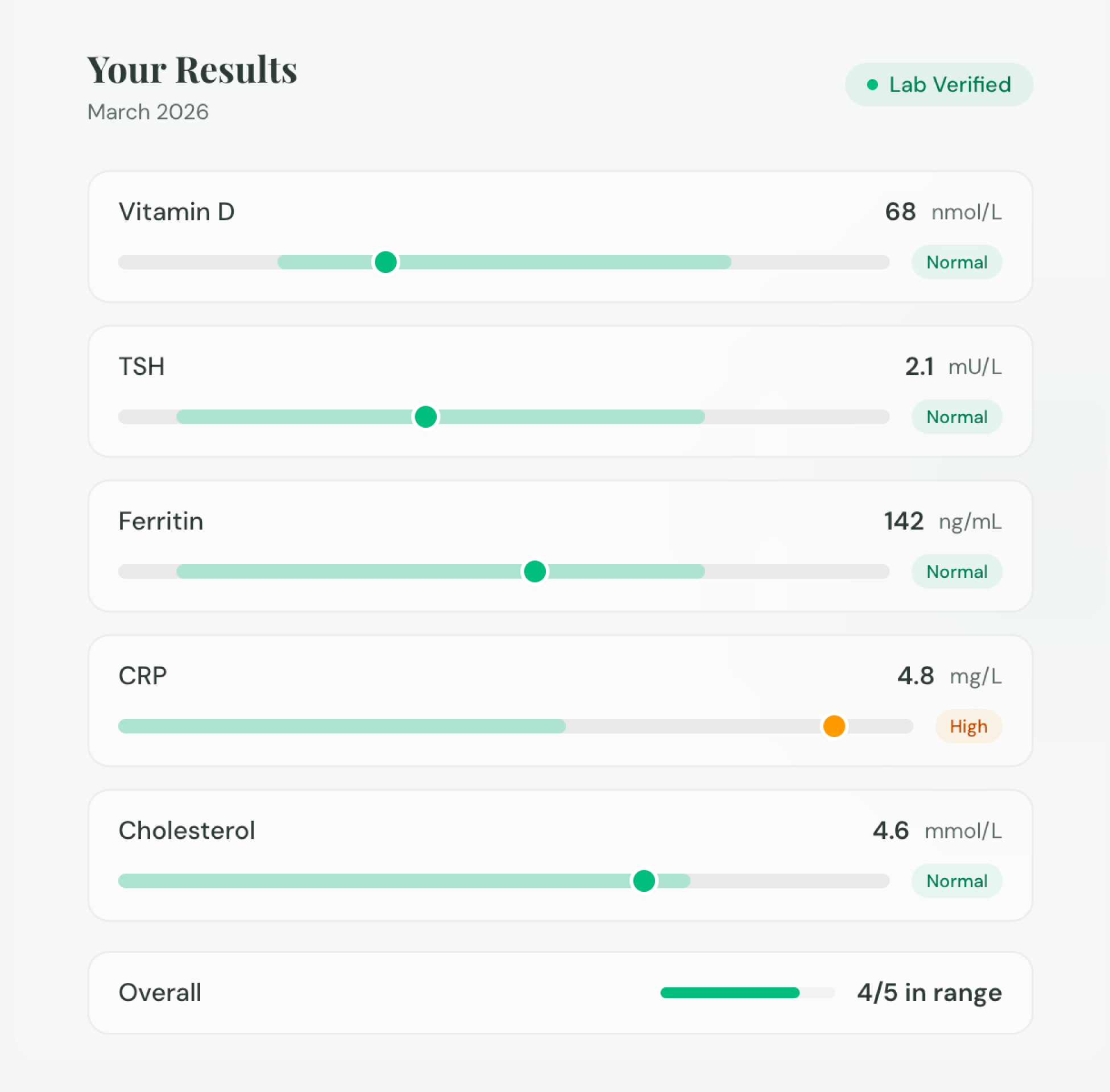
Your results are online within a few working days. For each value you see your own measurement next to the lab reference range, with a plain-language explanation.
Every result includes a professional assessment from a BIG-registered doctor. If a value falls outside the range, discuss it with your GP, who can weigh it against your symptoms, your medication and your history and decide whether follow-up testing makes sense.
Frequently Asked Questions
For the routine screen, yes: INR, aPTT, fibrinogen and platelets are the values a doctor starts with. A full workup adds further tests, which a doctor selects based on your symptoms and on this first set of results.
No. You can eat and drink as usual before the draw, and you can come in at any time of day.
No, that stays with your anticoagulation clinic. On anticoagulants it is not one isolated reading that counts but a fixed monitoring schedule: blood is drawn at set intervals, the trend is followed and the dose is adjusted directly. We do not do that.
A few working days. The slowest value in this panel sets the pace, and you get all four at once.
Usually not. Coagulation assays depend on the reagent used, so ranges differ between laboratories and a value just outside one is more common than you would expect. A single mild deviation without any bleeding symptoms rarely means disease. Do still raise it with your GP.
What We Test
| No. | Biomarker | Unit | Turnaround |
|---|---|---|---|
| 01 | INR | — | 5 days |
| 02 | Platelets (Thrombocytes) | 10^9/l | 1 day |
| 03 | Fibrinogen | g/l | 4 days |
| 04 | aPTT | sec. | 3 days |
| Your result arrives once the slowest test is finished: 5 days. This is indicative; turnaround varies per laboratory. | |||
Preparation
-
Preferably in the morning
RecommendedA morning draw makes this value easiest to compare with its reference range. Plan the draw before 10:00 if you can.
- Water is always fine. Drink as usual beforehand, it makes the draw easier.
- Take your usual medication, unless your own doctor told you otherwise.
Extend this panel
Same draw, no second appointment.
Related Health Panels
Fatigue
Investigate some common causes of fatigue: CBC, thyroid, iron, vitamins, glucose, and HbA1c.
Iron Studies
Iron panel: Iron, Ferritin, Transferrin, and Transferrin Saturation.
Anemia
Anemia workup: hemoglobin, iron, transferrin, CBC, and B12.