Complete coagulation panel: eight values from one blood draw
Eight coagulation values in one draw, including prothrombin time, thrombin time, D-dimer and antithrombin III.
Important to know
Do not order this panel within roughly three months of a clot, or while you are taking anticoagulants. Antithrombin III is consumed during a clot and lowered by heparin, and D-dimer will be raised almost regardless, without telling you anything new. You would receive numbers nobody can interpret. Wait until you are at least three months clear of treatment, or discuss it with your doctor first.
Add to your order
No referral needed
Added to your order
Click the button to view your cart
Included Markers
8 markersINR, Thrombin Time, Platelets (Thrombocytes), Fibrinogen, aPTT, D-Dimer, Antithrombin III (Activity), PT (Prothrombin Time)
A four-value coagulation screen shows whether the chain is faltering somewhere. This extended panel measures eight: alongside INR, aPTT, fibrinogen and platelets it adds prothrombin time, thrombin time, D-dimer and antithrombin III. Between them they cover how a clot is built, how it is broken down again, and the natural brake on the whole process.
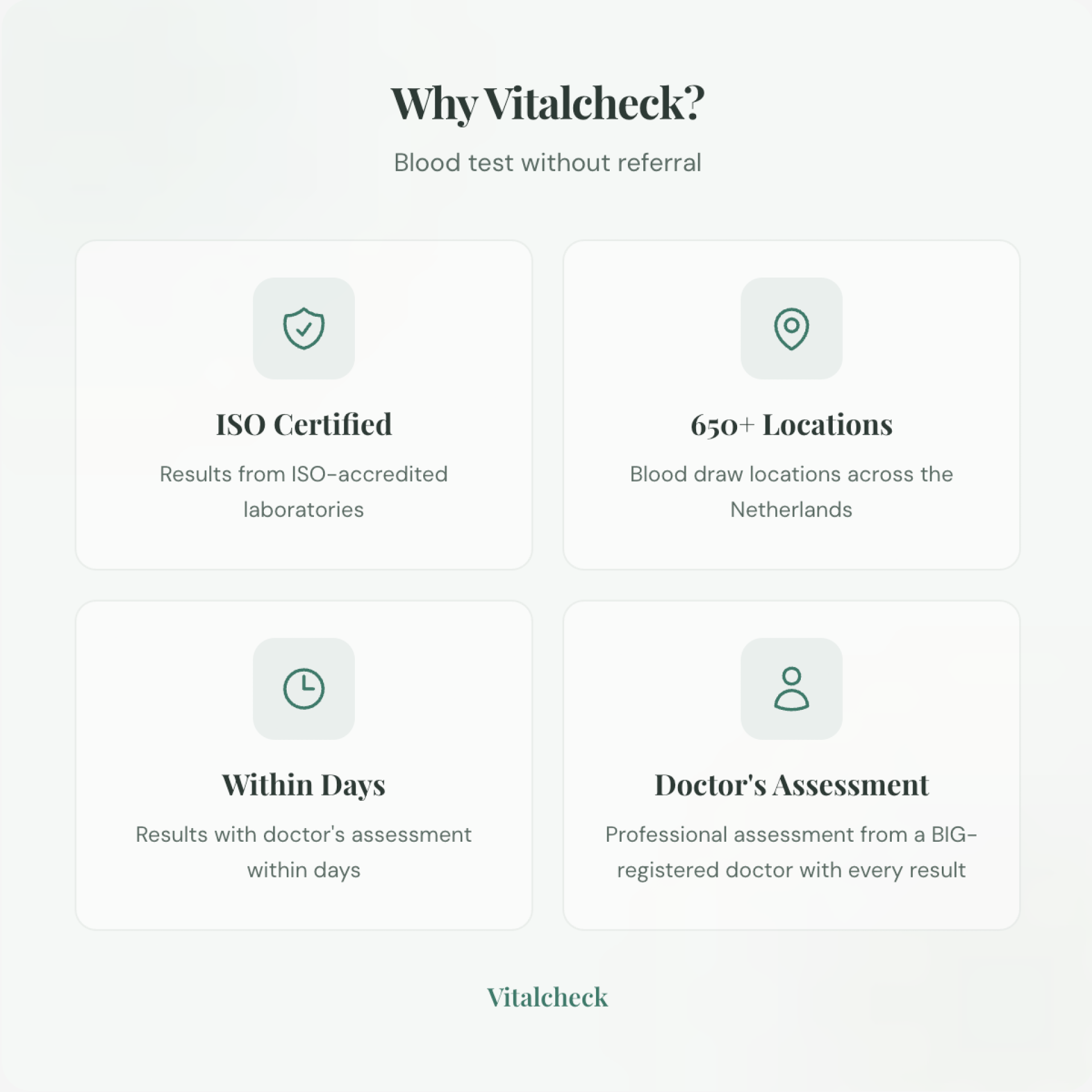
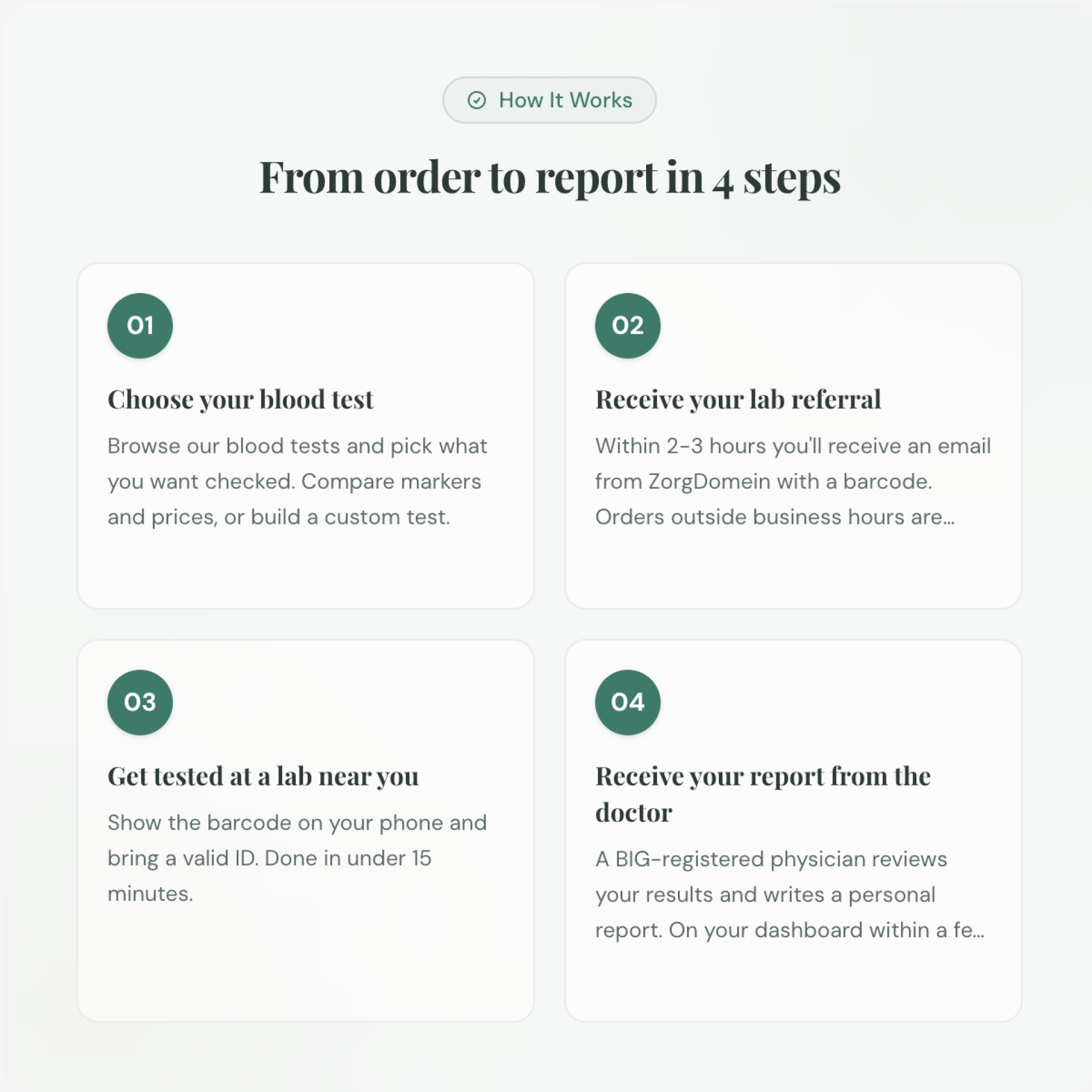
You order online, need no referral and have your blood drawn at one of our 700+ certified sample points. All eight values come from a single draw and are ready within a few working days, reviewed by a BIG-registered doctor.
Why this test?
A four-value screen tells you whether the clotting chain is slowed and at which end. This panel starts where that screen stops. It adds four measurements that each look at the same chain from a different angle, so a single draw leaves you with more than just a direction to search in.
Prothrombin time (PT) measures the same laboratory reaction as the INR, but reports it in seconds rather than as a ratio. A laboratory report puts the two side by side, which is why you see both here. Thrombin time isolates the final step of the chain: the conversion of fibrinogen into fibrin. D-dimer measures something different again, namely the fragments left behind when the body breaks a clot down. And antithrombin III is the body's own brake on clotting, the protein that keeps the chain from running on further than it should.
This tier is for people who would rather get all eight values out of one appointment than come back for a second. If you only want to know whether the basics are in order, the four-value coagulation panel covers that.
Who is this test for?
This extended coagulation panel may suit:
- people for whom bruising or prolonged bleeding has become more frequent than it used to be
- people whose doctor asked for clotting values and who would rather not wait for a referral
- people in whose family a bleeding or clotting disorder has been diagnosed
- people with liver disease, since the liver makes the proteins this panel measures
- people with clots in the family who want to see where their values sit before starting oestrogen-containing contraception or a pregnancy
- people already being investigated who want concrete numbers to bring into a consultation
There is one group this panel is not for, and that exclusion holds as firmly as the rest of the list. Do not order it within roughly three months of a clot, or while you are taking anticoagulants. Antithrombin III is consumed while a clot forms and is lowered by heparin, and D-dimer stays raised throughout that period. The result would not be readable. And if you take anticoagulants and want your INR checked so your dose can be adjusted, that monitoring stays with your anticoagulation clinic.
What is tested?
You get eight values, spread across the whole chain:
- INR: the standardised result of the clotting route that starts outside the vessel, which is what makes labs comparable with each other.
- PT (prothrombin time): the same reaction, reported in seconds instead of as a ratio.
- aPTT: how long the route that starts inside the vessel takes to complete.
- Thrombin time (TT): the final step measured on its own, fibrinogen turning into fibrin.
- Fibrinogen: how much raw material is available for the conversion the thrombin time measures.
- Platelets: how many platelets are available to make that first plug with.
- D-dimer: the fragments released when a clot is broken down again.
- Antithrombin III (activity): how well the natural brake on clotting is working.
Seeing both INR and PT on that list is not duplication. They come from one and the same laboratory reaction: the lab times the clot in seconds and converts that figure into the INR. A laboratory report gives the two together as a matter of routine, and so do we.
All eight sit in the Coagulation category, where each value is explained in more depth.
What can this test tell you?
The four screening values show whether the chain is slowed and at which end. The four additions fill in points the screen leaves open.
A normal D-dimer makes it unlikely that a clot formed recently. Ruling out is what the assay is good at, though a normal result lowers the likelihood rather than excluding a clot outright; how much weight it carries depends on the clinical suspicion. In the other direction it works far less well. A raised D-dimer has many possible causes and means little by itself; how likely a clot actually is remains a clinical judgement, made by a doctor from your symptoms and your situation rather than from the number.
A low antithrombin III can be inherited, but far more often it is acquired: through liver disease, protein lost through the kidneys, a recent clot, or treatment with heparin. One low reading is therefore not a conclusion. What it means depends on what else is going on, which is exactly what a doctor weighs alongside it.
No single value in this panel establishes a clotting disorder on its own. What the panel does is sharpen the question and give a doctor a starting point for whatever may be needed next.
How is the sample collected?
The sample is a venous draw, taken at one of our 700+ certified sample points across the Netherlands. Which location, and which slot, is yours to choose once the order is in.
All eight values come from that same draw, so the four extra measurements do not mean a second visit.
Coagulation assays are collected into a citrate tube that has to be filled exactly to the mark and reach the lab quickly, or the results drift. That is why trained staff take the sample at a certified location, rather than you taking it at home.
When is this test useful?
This extended panel can be useful:
- when an earlier coagulation screen showed something and you want more values before a follow-up consultation
- when clots run in your family and you want to see where your values sit before starting oestrogen-containing contraception or a pregnancy
- ahead of a planned procedure where a clinic or dentist has asked for a wider set of clotting values
- while monitoring known liver disease, since the liver makes both the clotting factors and antithrombin III
- but not within roughly three months of a clot, and not while you are on anticoagulants: wait until treatment is far enough behind you, because until then the values cannot be read
What do the results mean?
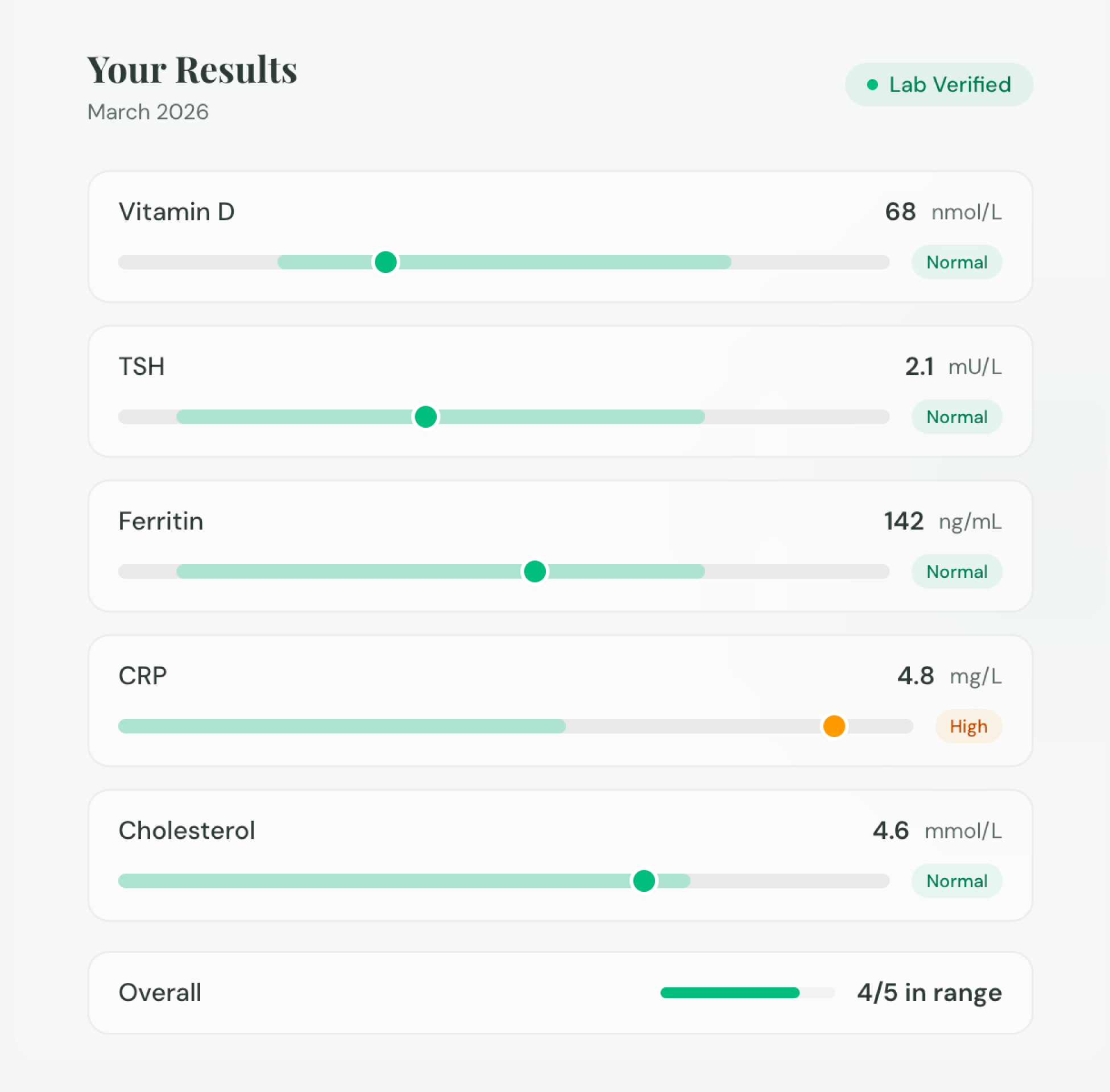
Each value is shown next to the reference range of the laboratory that analysed your blood. That weighs more heavily for coagulation assays than for many other tests: the result depends on the reagent and the analyser used, so ranges differ from lab to lab. The same thrombin time can land mid-range at one lab and just above the range at another.
D-dimer carries one extra caveat. The value climbs with age and rises with pregnancy, infection, recent surgery, inflammation and cancer. In someone with no symptoms, a raised D-dimer is therefore usually traceable to one of those, and not to a clot.
A value outside the range is not a diagnosis. It means this measurement differs from what the lab sees in most people. Mild deviations in a single value are found regularly in people who have never had a bleed or a clot.
What happens after the results?
Your results are online within a few working days, with your own measurement shown next to the lab reference range for each value and a plain-language explanation. Every result includes a professional assessment from a BIG-registered doctor.
If all eight values sit inside the range, that is a quiet baseline for those eight measurements. Inherited clotting variants such as factor V Leiden are not among them, so do not let a decision about oestrogen-containing contraception or a pregnancy rest on this result alone; take it to your GP first. The FAQ below sets out what a thrombophilia workup adds. If antithrombin III is abnormal or D-dimer is raised, book an appointment with your GP rather than repeating the measurement yourself. Your GP can weigh the values against your symptoms, your medication and your history, and decide whether follow-up testing makes sense and which.
Frequently Asked Questions
This panel contains those same four values and adds four more: prothrombin time in seconds, thrombin time, D-dimer and antithrombin III. Prothrombin time and thrombin time map the chain step by step, D-dimer looks at how a clot is broken down again, and antithrombin III looks at the natural brake on clotting.
Because they come from one laboratory reaction, reported two ways. The lab times how long the sample takes to clot, in seconds, and that is the prothrombin time. The INR converts that figure using the reagent's own factor, so results from different laboratories can be compared. Reports normally show both, so we show both.
Not yet. Antithrombin III is consumed while a clot forms and is lowered further by heparin, and D-dimer is raised almost regardless during that period. Both values would come back abnormal for a reason that says nothing about your underlying situation. Wait until you are at least three months clear of the clot and off anticoagulants, or ask your doctor when the timing is right.
No. A normal D-dimer clearly lowers the likelihood of a recent clot, which is what the assay is for, but how much weight that carries depends on how suspicious the clinical situation was to begin with. That judgement belongs to a doctor, not to a number. If you have sudden shortness of breath, chest pain, or a painful swollen leg, seek medical care rather than ordering a test.
No. A thrombophilia workup adds tests this panel does not carry, such as factor V Leiden, the prothrombin G20210A variant, protein C, protein S and antiphospholipid antibodies. Which of those are worth doing depends on your history and on who in your family was affected, so a doctor selects them individually. This panel gives you the coagulation values that come before that decision.
What We Test
| No. | Biomarker | Unit | Turnaround |
|---|---|---|---|
| 01 | INR | — | 5 days |
| 02 | Thrombin Time | s | 2 days |
| 03 | Platelets (Thrombocytes) | 10^9/l | 1 day |
| 04 | Fibrinogen | g/l | 4 days |
| 05 | aPTT | sec. | 3 days |
| 06 | D-Dimer | ug/l | 2 days |
| 07 | Antithrombin III (Activity) | % | 5 days |
| 08 | PT (Prothrombin Time) | sec | 2 days |
| Your result arrives once the slowest test is finished: 5 days. This is indicative; turnaround varies per laboratory. | |||
Preparation
-
Preferably in the morning
RecommendedA morning draw makes this value easiest to compare with its reference range. Plan the draw before 10:00 if you can.
- Water is always fine. Drink as usual beforehand, it makes the draw easier.
- Take your usual medication, unless your own doctor told you otherwise.
Extend this panel
Same draw, no second appointment.
Related Health Panels
Fatigue
Investigate some common causes of fatigue: CBC, thyroid, iron, vitamins, glucose, and HbA1c.
Iron Studies
Iron panel: Iron, Ferritin, Transferrin, and Transferrin Saturation.
Anemia
Anemia workup: hemoglobin, iron, transferrin, CBC, and B12.