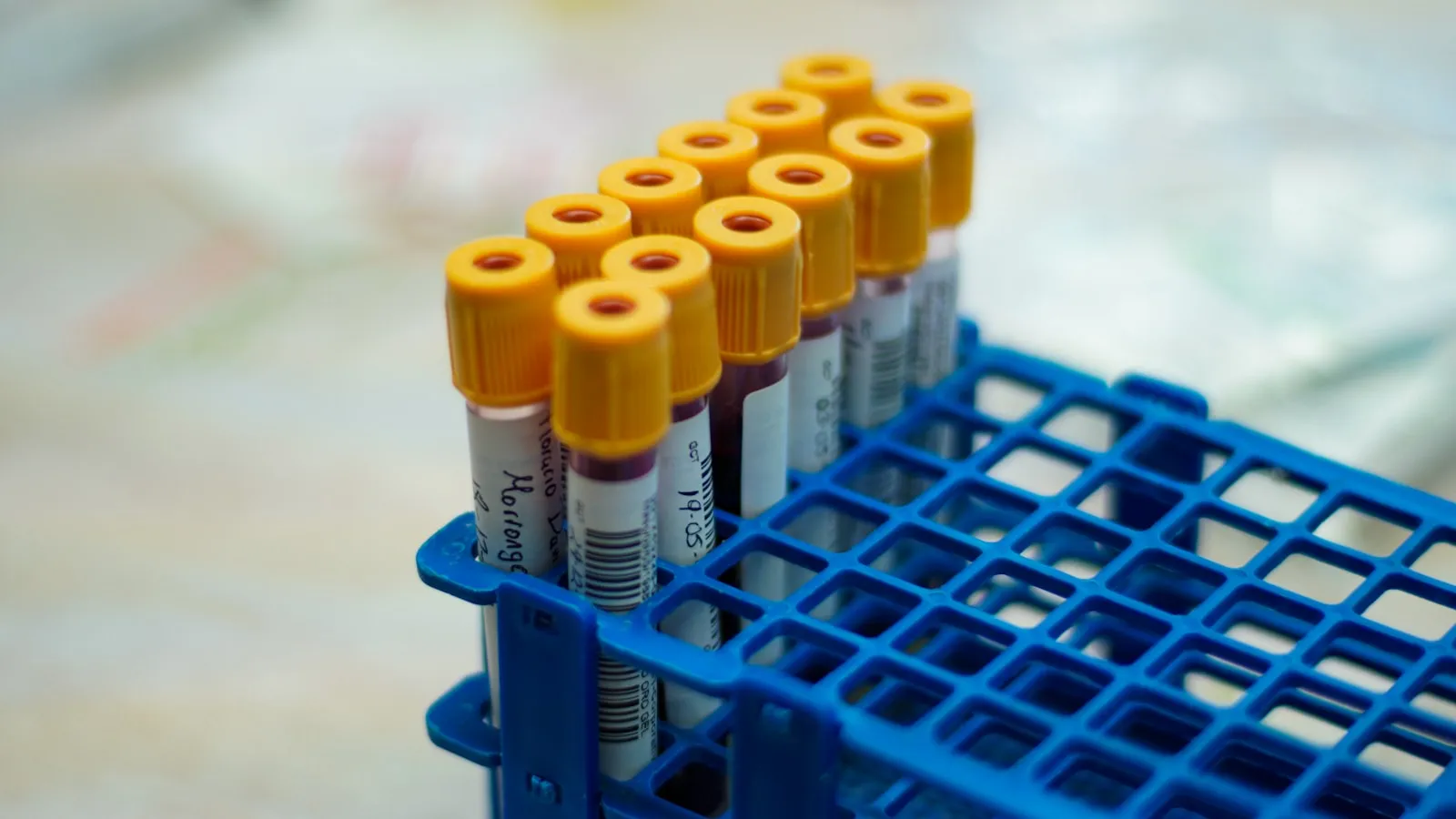
One line on your result sits in red: lymphocytes 1.1 ×10⁹/L, reference 1.5 to 4.0. A low lymphocyte count is called lymphopenia. It is usually temporary, and it often follows an infection you have already had.
What strikes me about the Dutch search results: they jump from "too low" straight to HIV, bone marrow and cancer. Those causes are real. They just sit at the bottom of the list, not the top.
Two things almost no page explains. The first is that lymphocytes appear twice on your result, and only one of those two numbers carries meaning. The second is timing.
Together they decide whether your 1.1 means something or nothing.
What do lymphocytes mean in a blood test?
Lymphocytes are the white blood cells of your adaptive immune system. There are three types: T cells, B cells and natural killer cells. B cells make antibodies, T cells recognise infected cells. The lab counts how many of these cells circulate in your blood at that one moment of the draw.
Your immune system has two layers. Innate immunity reacts within minutes to almost any intruder, adaptive immunity learns to recognise a pathogen and remembers it (PMID 20176265). Lymphocytes carry that second layer.
That memory is exactly why a vaccination works.
How the two layers work together sits in our overview of how your immune system works. It also covers which other values say something about your resistance.
What is the difference between leukocytes and lymphocytes?
Leukocytes is the collective name for all your white blood cells. Lymphocytes are one group within that, normally around 20 to 45 percent. The other groups are the granulocytes (neutrophils, eosinophils and basophils) and the monocytes. Together they form the leukocyte differential on your result.
Neutrophils are usually the largest group. They therefore drive much of what your total leukocyte count does, and so also what your lymphocyte percentage does.
What each of those groups does is set out in the article on granulocytes. For the total count there is a separate piece on leukocytes and their normal value.
When are lymphocytes too low?
In adults doctors speak of lymphopenia from roughly 1.0 to 1.5 ×10⁹/L, depending on the laboratory. That is the absolute count, not the percentage. The percentage can sit neatly inside its range while the absolute count falls below the lower limit, and the other way round.
Those two columns confuse almost everyone. Here is what each one does and does not say.
| On your result | Typical adult range (indicative) | What a change here means | What it does not mean |
|---|---|---|---|
| Lymphocytes absolute (×10⁹/L) | about 1.0 to 3.5 | The real number of cells in your blood has fallen or risen | Nothing about the cause: that follows from context, not from the number |
| Lymphocytes percentage (%) | about 20 to 45 | The share within your white blood cells has shifted | Not that you have more or fewer lymphocytes than before |
| Percentage low, absolute normal | happens regularly | Usually your neutrophils have risen relatively | Not that lymphopenia is present |
| Percentage normal, absolute low | the combination that gets missed | Your total leukocytes have fallen along with it | Not that your result is reassuring |
The numbers in this table are indicative. Every laboratory sets its own reference ranges, and the range printed beside your own result is the range that counts. So never compare your value with a number from a different lab.
Work it through once and you see it immediately. Someone with 30 percent lymphocytes and leukocytes of 8.0 ×10⁹/L lands on 2.4 ×10⁹/L: comfortably inside the range. Someone with that exact same 30 percent and leukocytes of 3.5 ×10⁹/L lands on 1.05 ×10⁹/L: low.
Same percentage, opposite conclusion.
It works the other way too. If your total leukocytes fall, your lymphocyte percentage rises on its own, without a single extra lymphocyte. A "high percentage" is then an arithmetic side effect, not a finding.
What can a low lymphocyte count mean?
Usually something temporary, and that ordering is frequency rather than a consolation prize. A recent viral infection tops the list, followed by corticosteroids such as prednisone, heavy physical strain, alcohol, undernutrition and surgery. Autoimmune disease, HIV, chemotherapy, radiotherapy and bone marrow disorders sit lower, but they do belong on it.
- Recent infection. Flu, glandular fever, a respiratory infection or a coronavirus can keep your lymphocytes low for days to weeks.
- Medication. Prednisone and other corticosteroids can lower the count within a day. Chemotherapy and immunosuppressants do the same, and often for longer.
- Strain and nutrition. Heavy stress, short sleep, a lot of alcohol and a shortage of protein or zinc can all play a part.
- Conditions. Lupus, HIV, kidney failure and bone marrow disorders lower the count structurally.
The common cold is the most everyday trigger of all. Adults get an average of two to three colds a year, children considerably more (PMID 12517470). RIVM, the Dutch national institute for public health, tracks which respiratory infections are circulating at any given time.
Give blood shortly after such an episode and you measure an immune system that is still clearing up.
Thuisarts, the GP-backed patient information site, consistently frames an abnormal blood result as a reason to talk to a doctor, not as a diagnosis. That is exactly the right register for this number.
How long do lymphocytes stay low after an infection?
Often days to a few weeks. During and after an infection, lymphocytes move out of your blood into your lymph nodes and tissue, which is where the work is. They have not disappeared, they are simply somewhere else. Your tube of blood therefore sees fewer cells than your body holds.
That makes the moment of the draw more important than most people think.
Take two people, both at 1.1 ×10⁹/L. The first was in bed with flu three weeks ago and now feels fine again. The second has not been ill, notices nothing, and already had 1.1 six months ago.
Same number, very different meaning. For the first, a repeat measurement after some weeks is usually the logical next step. For the second it is no longer about one measurement, but about a line that holds.
One low number is a snapshot. Two low numbers with weeks in between are a pattern.
How high can lymphocytes be?
In adults the upper limit usually sits around 3.5 to 4.0 ×10⁹/L, again depending on the lab. Children run far higher by nature: a toddler can pass 7 ×10⁹/L with nothing wrong at all. Age therefore belongs in the interpretation.
At the top end too, the absolute count weighs more than the percentage.
A percentage of 50 says little if your total leukocytes are low. At leukocytes of 3.0 ×10⁹/L, 50 percent comes to just 1.5 ×10⁹/L lymphocytes, which falls inside the range.
What if lymphocytes are too high?
A raised count is called lymphocytosis and in adults it usually comes from an infection. Glandular fever (the Epstein-Barr virus), whooping cough and other viral infections are the classic causes. If the value stays raised for months without an infection, certainly over the age of 50, that calls for a medical assessment.
In children a high value during an infection is the expected picture.
To see how lymphocytes relate to the rest of your result, the piece on what the parts of your blood count mean helps.
How serious is a low lymphocyte count?
At group level, lymphopenia is associated with a higher risk of infection and of death. In a Danish study of 98,344 people from the general population that also held for participants who felt perfectly well (PMID 30383787). That is an association in a large group, not a prediction for you personally.
That distinction is the whole point of this section.
A second analysis looked at lymphopenia found by chance, so without a complaint prompting the measurement. There too the researchers saw higher mortality at group level, stronger the lower the value sat (PMID 31932337).
I find this the hardest part to write honestly. Leaving it out feels like withholding something. Overstating it turns a statistical association into a personal verdict, which it is not.
What these studies mainly show: a persistently low count deserves a doctor's attention. They say nothing about what will happen to you. Many people with a mildly reduced value notice nothing from it.
What do you do with a low result?
You read it beside your own story. Note the absolute count, your total leukocytes, the date of the draw and whether you were ill in the six weeks before it. Add your medications, prednisone first. Put that note in front of your GP.
That is a more concrete question than "is this bad".
If a persistently low value comes with a pattern of infections, a doctor often looks beyond the cell count alone. Antibodies belong there, and what they say sits in the article on immunoglobulins IgG, IgA and IgM.
To follow your own value, you can look at lymphocytes separately or include them in a broader panel such as the extended health checkup. Always read the result next to your leukocytes, never on its own.
Concretely: write down your absolute lymphocyte count with your own lab's reference range beside it, and add whether you have been ill. Ask your GP whether a repeat measurement makes sense for you. That conversation gives you more than another evening of searching.
References
- Chaplin DD. Overview of the immune response. J Allergy Clin Immunol. 2010;125(2 Suppl 2):S3-S23. PMID 20176265.
- Warny M, Helby J, Nordestgaard BG, et al. Lymphopenia and risk of infection and infection-related death in 98,344 individuals from a prospective Danish population-based study. PLoS Med. 2018;15(11):e1002685. PMID 30383787.
- Warny M, Helby J, Sengeløv H, et al. Incidental lymphopenia and mortality: a prospective cohort study. CMAJ. 2020;192(2):E25-E33. PMID 31932337.
- Heikkinen T, Järvinen A. The common cold. Lancet. 2003;361(9351):51-59. PMID 12517470.
- Thuisarts and RIVM. Patient information on blood testing and on infectious diseases in the Netherlands. Available via thuisarts.nl and rivm.nl.
Every blood test result at Vitalcheck includes a professional assessment by a BIG-registered doctor. A blood value is not a diagnosis: always discuss treatment decisions with your GP.
Author
Vitalcheck
Dr. Naimi, BIG-registered physician, oversees the medical standards behind our content and assessments. Read our medical policy
Related Tests
Related Posts

Weakened immune system: causes and which blood values give insight

Frequent colds: when is it actually your immune system?