What does clove do to your body? At the amounts you use in a stew or spiced biscuit, mainly this: it adds flavour, it slows bacterial growth in your mouth, and it makes a modest contribution to your antioxidant intake. The striking effects from laboratory research belong to doses you will never reach through food.
That distinction between kitchen dose and study dose is missing from almost every article about clove. So that is where this piece starts.
What is actually in clove?
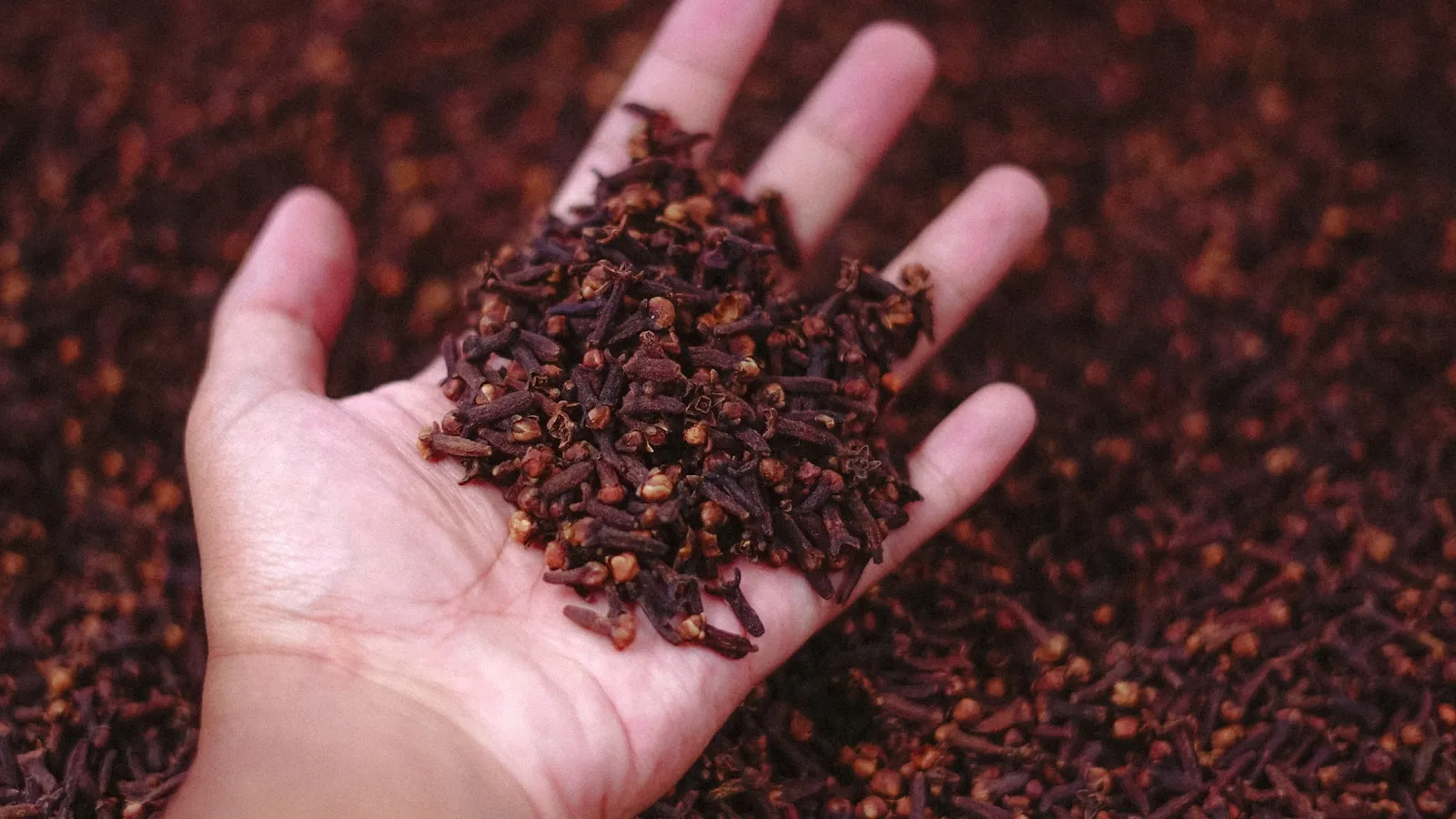
Clove is the dried flower bud of Syzygium aromaticum. What makes it unusual is its essential oil, which is roughly 70 to 90 percent eugenol. That is an exceptionally high share for a single compound in a single spice.
Eugenol is responsible for the aroma, the slightly numbing tingle on your tongue and most of the measured biological activity. Clove also contains flavonoids, phenolic acids, manganese and a little fibre (Haro-González et al., 2021. PMID 34770801).
A whole clove weighs about 0.1 gram. That is the scale to keep in mind: four cloves in a pan of apple sauce is under half a gram of spice, spread across six portions.
What does research say clove does to your body?
Most claims come from laboratory and animal research using isolated eugenol at concentrations far above a kitchen amount. That does not make the research worthless, but it does make it something other than advice about your dinner.
| Claim | What the research shows | At which dose |
|---|---|---|
| Inhibits bacteria | Well supported in lab research, eugenol damages the bacterial cell wall | Isolated oil, direct contact |
| Eases toothache | Traditional use, eugenol acts as a mild local anaesthetic | Oil, applied locally |
| Anti-inflammatory | Shown at cell level, reduces certain inflammatory messengers | Far above kitchen dose |
| Antioxidant | High activity in test-tube assays | Says little about your blood, see below |
| Aids digestion | Mostly traditional use, little human research | Unknown |
The antibacterial action is the best supported. A review describes how eugenol makes the bacterial cell membrane permeable, so the cell loses its contents (Marchese et al., 2017. PMID 28346030). That also explains why clove oil has been used for dental complaints for centuries.
Is it true that clove tops the antioxidant list?
That claim appears on dozens of sites, and it is out of date. It comes from the ORAC list, a ranking of antioxidant capacity that the US Department of Agriculture itself withdrew in 2012.
The reason for withdrawing it was clear: the ORAC value is measured in a test tube and says nothing about what happens in your body after digestion and absorption. Foods with a high score turned out to have no demonstrably greater health effect.
Clove did rank high on that list. The list itself simply was not a good measure. I find it striking how persistently a withdrawn ranking keeps circulating, fourteen years on.
When does clove carry a real risk?
With the oil, not with the spice. Clove oil is a heavily concentrated product, and serious poisonings have been described with it. The medical literature contains cases of liver failure after ingesting clove oil, particularly in young children (Janes et al., 2005. PMID 15895251).
Three points worth remembering:
- Clove oil should never be taken orally, and certainly not by children
- Eugenol may strengthen the action of blood thinners, which matters if you use them
- Large amounts of clove can cause stomach complaints and irritation of the mucous membranes
Imagine a 10 millilitre bottle of clove oil, holding roughly the eugenol of 100 grams of clove. You would never eat that. You might drink it, if you are not paying attention.
How much clove is normal?
As a flavouring there is no reason to hold back. A few cloves in a dish, a single one in tea, that falls within normal use. The Dutch nutrition centre Voedingscentrum gives no separate upper limit for clove, because the amounts used are so small.
Supplements are a different matter. Clove extract in capsule form delivers a multiple of a kitchen amount, and the safety margin there is simply less studied. In Europe there are no approved health claims for herbal extracts via EFSA, precisely because the human evidence is thin.
What does your blood say about this?
Honestly: little directly. There is no blood value that measures what clove does to you, and I would be wary of anyone suggesting otherwise. Spices in kitchen amounts do not move blood values.
There is one situation where measuring does make sense. If you take concentrated herbal extracts long term, your liver values are where a problem would show up first. That applies to herbal preparations in general, not specifically to clove.
To understand how food and blood values genuinely relate, nutrition and your blood values gives the overview. For nutrients that do have a measurable value attached, such as omega-3, there is what does omega-3 do to your body.
Frequently asked questions
How much clove can you have per day?
As a spice, a few cloves a day sits well within normal use. For extracts and oil no safe daily amount has been established, so caution is sensible there, certainly with blood thinners or liver problems.
Is clove tea healthy?
As a hot drink there is little against it. The amount of eugenol that steeps out of one or two cloves in water is small. Do not expect a measurable health effect from it, but do expect a strong flavour.
Does clove really help with toothache?
Eugenol acts as a mild local anaesthetic, which explains the traditional application. It is temporary pain relief, not treatment of the cause. Persistent toothache belongs with a dentist.
Can clove lower your blood sugar?
Some animal studies point that way, but convincing human research is missing. At kitchen amounts an effect on your blood sugar is unlikely. More on what does move your blood sugar is in lowering inflammation values with food.
References
- Haro-González JN, et al. Clove Essential Oil (Syzygium aromaticum L. Myrtaceae): Extraction, Chemical Composition, Food Applications, and Essential Bioactivity for Human Health. Molecules. 2021. PMID 34770801. PubMed
- Marchese A, et al. Antimicrobial activity of eugenol and essential oils containing eugenol: A mechanistic viewpoint. Critical Reviews in Microbiology. 2017. PMID 28346030. PubMed
- Janes SE, et al. Essential oil poisoning: N-acetylcysteine for eugenol-induced hepatic failure. European Journal of Pediatrics. 2005. PMID 15895251. PubMed
Author
Vitalcheck
Dr. Naimi, BIG-registered physician, oversees the medical standards behind our content and assessments. Read our medical policy