Whoop Performance Health
A 50-biomarker performance panel inspired by the WHOOP Performance Health Panel — recovery, blood production, thyroid, hormones, iron and nutrient status for people who train.
Hematocrit, what is that exactly? It is simpler than the word suggests. Your blood consists of fluid and cells, and hematocrit says what percentage of it is cells. If your report says 0.44, then 44 percent of your blood is red blood cells. Because it is a percentage, how much fluid you have in your blood counts too. If you drank little on the day of the test, the number comes out higher. No cells were added. Your blood was simply a little more concentrated.
Doctor's Assessment Included
Picture a tube of blood. Part of it is fluid, the plasma, and part consists of cells. Hematocrit tells you what share those cells take up.
Nearly all of those cells are red blood cells, and they carry oxygen around your body.
Dutch labs write the result as a decimal, for example 0.42 l/l. Abroad you more often see 42 percent. It is exactly the same number, written differently.
If you compare your result with an English site, check which of the two is shown.
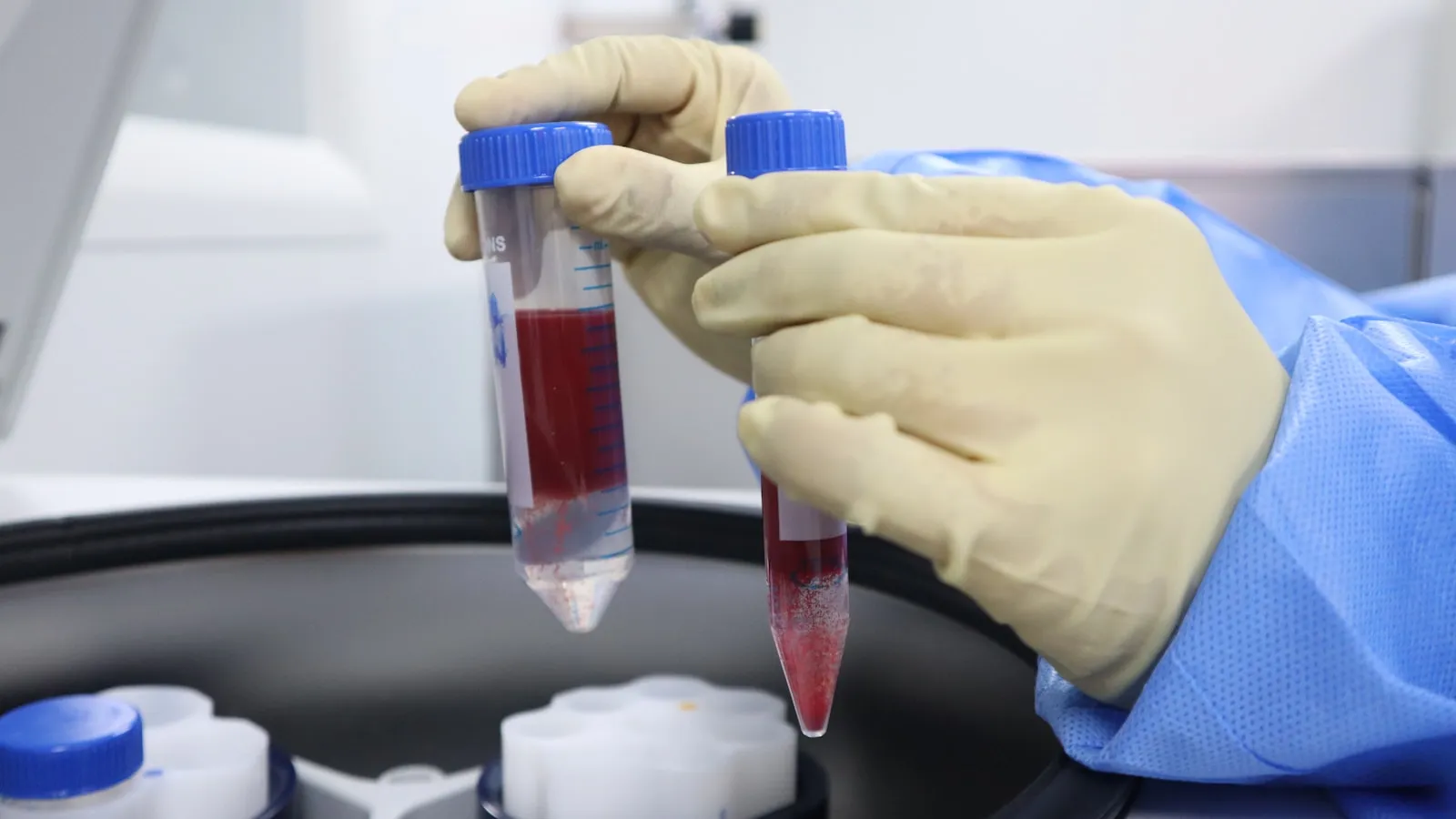
Blood used to be spun in a machine. You could then read off the layer of red cells. That no longer happens.
A device now counts your red blood cells and measures their average size. Those two numbers together produce your hematocrit.
The normal value depends on your sex and your age. Star-shl uses these values:
| Who | Normal value (l/l) |
|---|---|
| Men | 0.40 – 0.50 |
| Women | 0.35 – 0.45 |
| Children 1 – 5 years | 0.35 – 0.45 |
| Children 5 – 10 years | 0.36 – 0.47 |
| Children 10 – 15 years | 0.38 – 0.49 |
Every lab can differ a little here, because devices and methods vary. So always look at the range printed next to your own result. That is the range your result was compared against.
Hematocrit almost never appears alone on a report. It belongs to the complete blood count, together with your haemoglobin and your red blood cells.
The most useful thing to know about this value: it is a ratio, not a count. You are not measuring how many red blood cells you have. You are measuring how closely packed they are.
That sounds like a detail, but it explains almost everything that surprises people about their result. If the amount of fluid in your blood changes, the number changes. Even when not a single cell has been added or lost.
Take a high result. The most common reason is simply drinking too little. A sauna, a hot day or heavy sweating shortly before the test does the same.
Your blood thickens and the cells sit closer together. The number rises while nothing about your blood has changed.
It works the same way in reverse. If you carry a lot of fluid, the value drops. In pregnancy that happens naturally, and in people who do a lot of endurance sport too.
If your value stays high while you drink normally, other explanations apply. Smoking is one of them, because your body then makes more red blood cells. Sleep apnoea does the same, and often goes unnoticed for years.
With a low value a doctor thinks first of anaemia. That can come from blood loss, or from something missing that is needed to make new cells. Iron, vitamin B12 and folate are required for that.
Worth knowing: one abnormal number is not a diagnosis. Your doctor looks at the whole picture, and often at a second measurement. So do not be alarmed by an arrow next to your hematocrit.
You rarely request hematocrit on its own. It is a standard part of the complete blood count, so you usually get it included.
The commonest reason is a complaint that fits anaemia. Think of being tired despite enough sleep. Or getting out of breath on the stairs, and feeling dizzy when you stand up.
In a periodic check the value simply comes along too.
Preparation is simple. Fasting is not needed for this test. What does help: on the morning of the draw, drink what you always drink.
Skip the sauna and a heavy workout that morning.
There is one more thing many people do not know. Standing or sitting for a long time before the draw thickens your blood slightly. A tightly fastened band around your arm does the same.
Your result can come out a few percent higher because of it.
If you have the test repeated later, go at roughly the same time of day. Then you compare like with like. If you get an abnormal result, a repeat is often the logical next step.
Usually after a few weeks.
With a low hematocrit your tissues receive oxygen less easily. You usually notice that in your energy first. You feel tired despite enough sleep, and the tiredness does not lift after a restful weekend.
You may also get out of breath faster on stairs or cycling into the wind. Feeling dizzy when you stand up quickly belongs to it too. So do pale skin, cold hands and feet, and headache.
Some people notice their heart beating harder during normal activity. If the value fell slowly, you can feel surprisingly little for a long time. These complaints do not point to a cause on their own.
With a high hematocrit your blood is a little thicker, and it flows less easily. Headache and dizziness are then the complaints mentioned most often. A red or flushed face also occurs, as do blurred vision or ringing in your ears.
Itching after a hot shower stands out, because that complaint belongs fairly specifically to a high value. You may also feel tired or get tingling in your hands and feet. Even so, most people with a mildly raised result notice nothing at all.
It simply shows up in a blood test. With a high result, think first about how much you had drunk that day.
The most practical thing you can do is not about your blood but about your measurement. On the day of the test, drink what you always drink. Anyone sitting down dehydrated gets a result that mainly describes their fluid balance.
If you smoke, that is the main lever you control yourself. Smoking makes your body produce more red blood cells, so your value sits structurally higher. After quitting it falls again, but not immediately.
Red blood cells live about 120 days, so expect months.
Do you snore loudly, sometimes stop breathing in your sleep, or feel sleepy during the day? Discuss it with your doctor. Untreated sleep apnoea is one of the most missed reasons for a persistently high value.
If your value is low instead, it often comes down to building blocks. You need iron, vitamin B12 and folate to make red blood cells. Varied eating usually covers that.
Vitamin C with a meal helps you absorb iron better.
Do not start iron tablets on your own. Without a proven shortage they do not help. Your body also struggles to get rid of excess iron.
Have your ferritin measured first and discuss it with your doctor.
These panels measure values from the same category as this marker.
A 50-biomarker performance panel inspired by the WHOOP Performance Health Panel — recovery, blood production, thyroid, hormones, iron and nutrient status for people who train.
A 43-biomarker comprehensive health panel inspired by WHOOP Advanced Labs — a deep look at metabolism, cardiovascular risk, hormones, liver, kidney and inflammation.
Anemia workup: hemoglobin, iron, transferrin, CBC, and B12.
An InsideTracker blood test with 35 biomarkers: heart, hormones, metabolism, inflammation, recovery and iron status. Measured in the Netherlands.
Medical reviewer
Dr. Naimi oversees the medical standards behind our content and assessments.
Medical policyDoctor's Assessment Included
Every result includes a professional assessment from a BIG-registered doctor. For treatment decisions, discuss your results with your GP.
Hematocrit
€10,-