InsideTracker Hormone Balance blood test - 12 blood values
A 12-biomarker hormone panel inspired by InsideTracker's Hormone Balance category — estradiol, progesterone, testosterone, SHBG, DHEA-S, cortisol, TSH and the minerals behind your hormone score.
Add to your order
No referral needed
Added to your order
Click the button to view your cart
The InsideTracker Hormone Balance blood test measures the 12 blood values InsideTracker uses to score hormone balance: estradiol, progesterone, total and free testosterone, SHBG, DHEA-S, cortisol, TSH, fasting insulin, vitamin D, calcium and magnesium. Here you buy exactly that panel, drawn at a certified Dutch lab.
Your hormones work as a network: sex hormones, stress hormone, thyroid and insulin influence each other. This panel measures them together, plus the minerals they lean on.
Why this test?
InsideTracker gives members a Hormone Balance score from 0 to 100, calculated from a fixed set of blood values. If you search for InsideTracker in the Netherlands, you usually want those values measured without a membership and without shipping a sample to the United States.
This blood test is that alternative: the same 12 blood values behind the Hormone Balance category, drawn at a certified Dutch lab and returned digitally in your account, with an assessment by a BIG-registered doctor.
Who is this test for?
This panel may suit women and men who want a broad picture of their hormonal balance. It can be relevant for:
- Women with cycle complaints who want a broad baseline, alongside their GP's advice
- Women with questions about menopause or perimenopause
- Men and women with changes in energy, mood or libido
- People who want the InsideTracker Hormone Balance category measured in the Netherlands
What is tested?
This panel measures 12 blood values:
- Sex hormones: Estradiol, Progesterone, Total Testosterone, Free Testosterone (calculated), SHBG and DHEA-S.
- Stress and thyroid: Cortisol and TSH.
- Metabolism: Fasting Insulin.
- Vitamins and minerals: Vitamin D, Calcium and Magnesium.
What can this test tell you?
The results show how your sex hormones, your stress hormone, your thyroid and your minerals compare to the reference ranges. Because the panel is broad, the doctor can see connections that stay invisible in isolated measurements, such as a hormone picture that fits a thyroid or stress component.
If you are specifically after the athletic angle, our InsideTracker Fitness blood test is more compact. The full InsideTracker blood test measures 36 blood values in one go. Keep in mind that a single value is not a diagnosis.
How is the sample collected?
For this blood test, a staff member draws a small tube of blood at a certified location. You can choose from 700+ collection sites, so there is almost always a location near you.
You only need your appointment confirmation and a valid ID. The draw usually takes just a few minutes.
When is this test useful?
Some people choose to measure these values:
- When they want to map cycle or menopause complaints objectively
- When their energy, mood or libido noticeably changes
- When they want to see whether stress or their thyroid plays a role in their complaints
- When they want to repeat their US InsideTracker measurement in the Netherlands
What do the results mean?
What the results mean depends on your personal situation, your sex and, for women, your cycle phase: estradiol and progesterone fluctuate strongly through the cycle. Our reference ranges for these hormones are based on the follicular phase.
Always discuss any deviating values with your GP, so you know what the results may mean for you personally.
Preparation
Plan a morning draw: your testosterone and cortisol peak then, and your fasting insulin requires 10 to 12 hours without food. Women tracking their cycle preferably draw in the early follicular phase, day 2 to 5 of the cycle, for a comparable baseline.
Drink enough water on the day of the draw. If in doubt, discuss your situation with your GP.
What happens after the results?
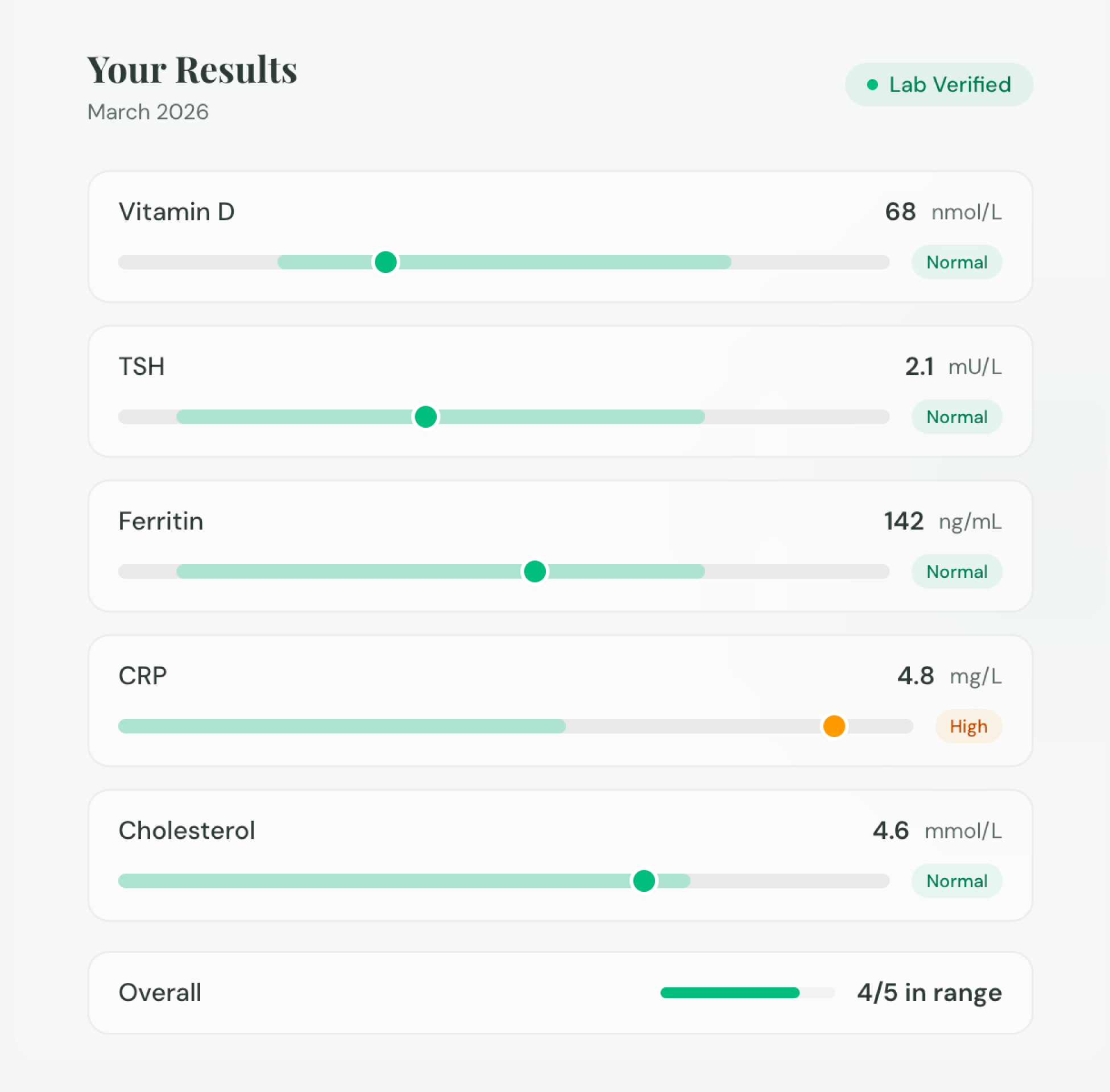
You receive your results digitally in your account, usually within a few working days. For each value, you can see whether it falls within the reference range.
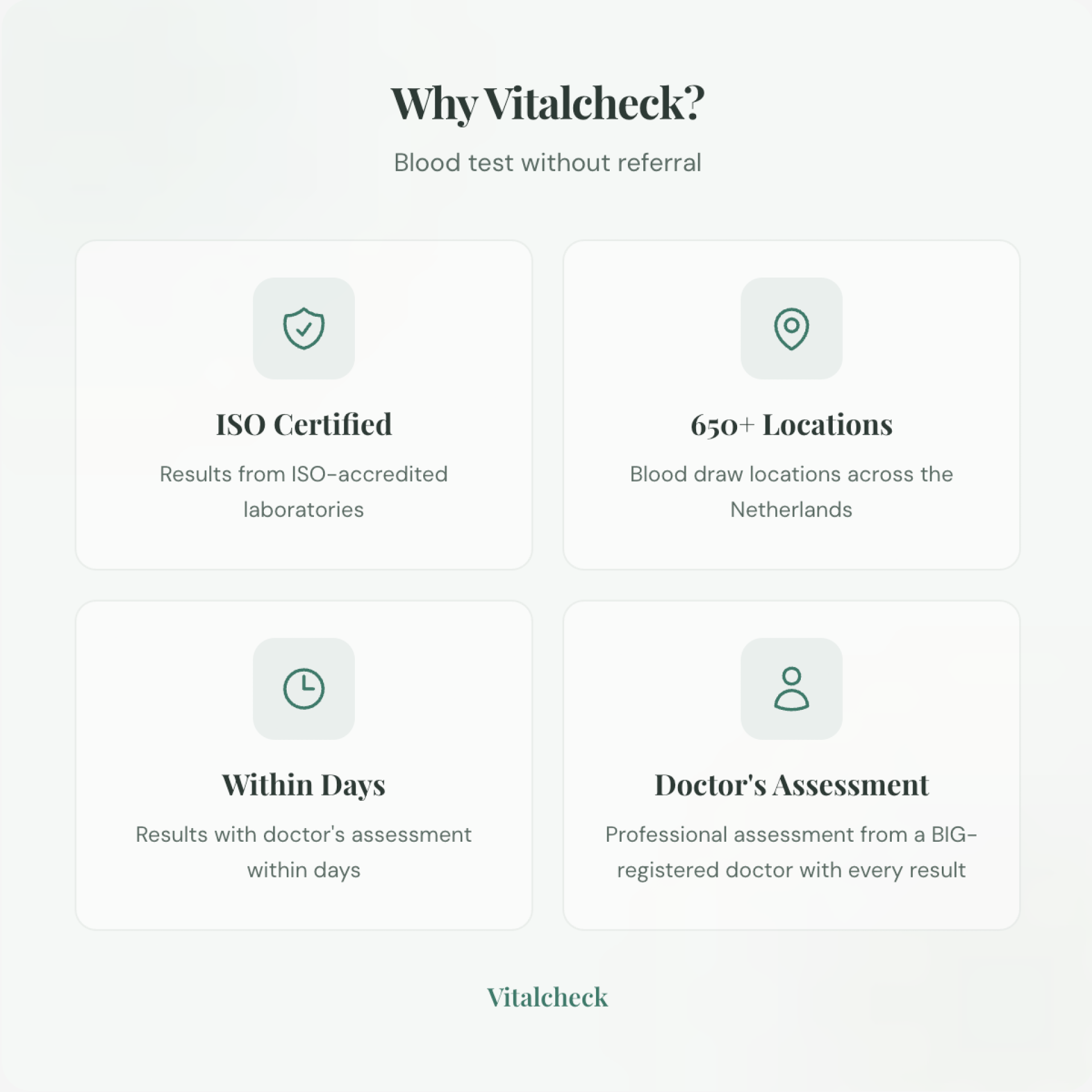
Every blood test result includes a professional assessment from a BIG-registered doctor. For treatment decisions, discuss your results with your GP.
Frequently Asked Questions
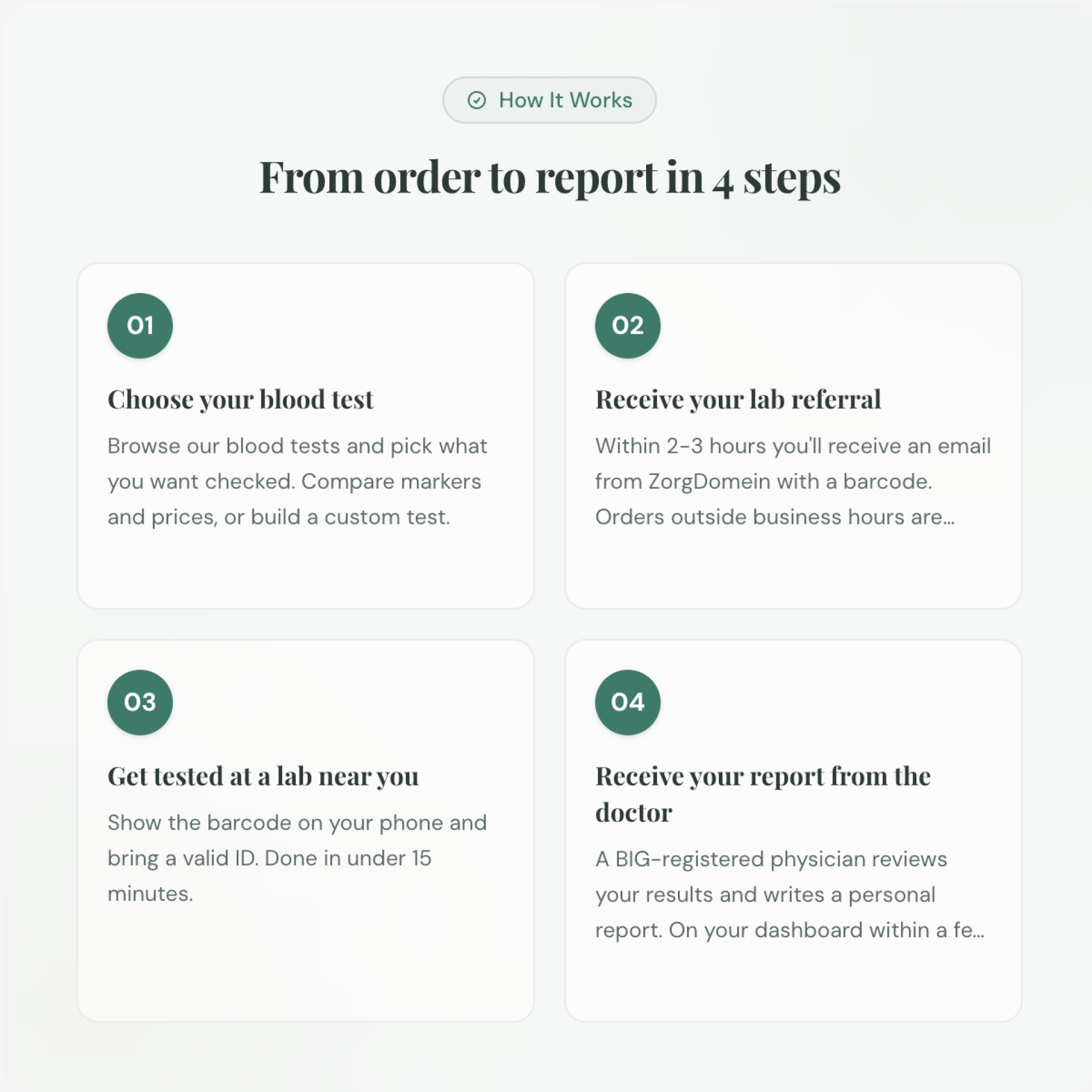
From order to report in 4 steps
A blood test without referral means no waiting. Just order and go.
Choose your blood test
Browse our blood tests and pick what you want checked. Compare markers and prices, or build a custom test.
Receive your lab referral
Within 1 business day you'll receive an email from ZorgDomein with a barcode. Orders outside business hours are processed from the next business day.
Get tested at a lab near you
Show the barcode on your phone and bring a valid ID. Done in under 15 minutes.
Receive your report from the doctor
A BIG-registered physician reviews your results and writes a personal report. On your dashboard within a few business days.
Choose your blood test
Browse our blood tests and pick what you want checked. Compare markers and prices, or build a custom test.
Receive your lab referral
Within 1 business day you'll receive an email from ZorgDomein with a barcode. Orders outside business hours are processed from the next business day.
Get tested at a lab near you
Show the barcode on your phone and bring a valid ID. Done in under 15 minutes.
Receive your report from the doctor
A BIG-registered physician reviews your results and writes a personal report. On your dashboard within a few business days.
Always a location near you
With 700+ certified phlebotomy points across the Netherlands.
What We Test
This health panel includes 12 biomarkers to give you a comprehensive picture of your health.
Estradiol (E2) is the most potent form of estrogen, playing a key role in reproductive health, bone density, and cardiovascular function. Abnormal levels may indicate hormonal imbalances that your healthcare provider can help evaluate.
Learn moreA progesterone blood test measures the level of progesterone, a hormone essential for the menstrual cycle and pregnancy. Progesterone is primarily produced by the ovaries after ovulation and plays a key role in preparing the uterus for implantation.
Learn moreTSH is thyroid-stimulating hormone. The pituitary gland makes it, and uses it to drive your thyroid. At the laboratory that runs the test the usual adult range runs from 0.27 to 4.20 mE/L. A high TSH usually fits an underactive thyroid. A low value usually fits an overactive one. That direction feels inverted, and it is. TSH is the pituitary signal, not the thyroid hormone itself. Laboratories use slightly different limits from one another. Always read the reference value printed on your own result. And a single measurement is never a diagnosis.
Learn moreFasting insulin measures the amount of insulin in your blood after an overnight fast. It helps assess how efficiently your body manages blood sugar and can reveal insulin resistance before glucose levels become abnormal.
Learn moreDHEA-S (dehydroepiandrosterone sulfate) is the most abundant adrenal hormone and serves as a precursor to both oestrogen and testosterone. It declines naturally with age and reflects overall adrenal reserve.
Learn moreFree testosterone is the unbound, bioavailable form of testosterone that can directly enter cells and activate receptors. It may indicate your body's functional androgen activity. Your healthcare provider can help interpret what your levels mean.
Learn moreCalcium is the most abundant mineral in the body, essential for strong bones and teeth, muscle contraction, nerve signalling, and blood clotting. Most calcium is stored in bones and teeth, with a small amount circulating in the blood.
Learn moreCortisol is the body's primary stress hormone, produced by the adrenal glands. It regulates metabolism, immune responses, and the sleep-wake cycle. Levels follow a natural daily rhythm, peaking in the morning and declining throughout the day.
Learn moreSHBG stands for sex hormone binding globulin. It is a protein made by the liver. SHBG binds testosterone tightly and oestradiol somewhat more loosely. Hormone bound to SHBG cannot act in the tissues. SHBG therefore determines how much of your total testosterone is genuinely available. SHBG is not itself a sex hormone but a transport protein. Results are reported in nmol/l. Normal values differ by sex and by age, and in men SHBG rises as they get older. An SHBG should therefore be assessed alongside total testosterone, never on its own.
Learn moreTotal testosterone measures the combined amount of bound and free testosterone in the blood. As the primary androgen, testosterone may influence muscle mass, bone density, libido, mood, and energy levels in both men and women.
Learn moreVitamin D is a fat-soluble vitamin that plays a key role in calcium absorption, bone health, and immune function. It is primarily produced in the skin through sunlight exposure and can also be obtained from certain foods and supplements.
Learn moreMagnesium is an essential mineral involved in over 300 enzymatic reactions in the body, including energy production, muscle and nerve function, blood sugar regulation, and bone development.
Learn moreEstradiol (E2)
HormonesEstradiol (E2) is the most potent form of estrogen, playing a key role in reproductive health, bone density, and cardiovascular function. Abnormal levels may indicate hormonal imbalances that your healthcare provider can help evaluate.
Learn moreProgesterone
HormonesA progesterone blood test measures the level of progesterone, a hormone essential for the menstrual cycle and pregnancy. Progesterone is primarily produced by the ovaries after ovulation and plays a key role in preparing the uterus for implantation.
Learn moreTSH (Thyroid Stimulating Hormone)
ThyroidTSH is thyroid-stimulating hormone. The pituitary gland makes it, and uses it to drive your thyroid. At the laboratory that runs the test the usual adult range runs from 0.27 to 4.20 mE/L. A high TSH usually fits an underactive thyroid. A low value usually fits an overactive one. That direction feels inverted, and it is. TSH is the pituitary signal, not the thyroid hormone itself. Laboratories use slightly different limits from one another. Always read the reference value printed on your own result. And a single measurement is never a diagnosis.
Learn moreInsulin (Fasting)
MetabolicFasting insulin measures the amount of insulin in your blood after an overnight fast. It helps assess how efficiently your body manages blood sugar and can reveal insulin resistance before glucose levels become abnormal.
Learn moreDHEA-S
HormonesDHEA-S (dehydroepiandrosterone sulfate) is the most abundant adrenal hormone and serves as a precursor to both oestrogen and testosterone. It declines naturally with age and reflects overall adrenal reserve.
Learn moreFree Testosterone
HormonesFree testosterone is the unbound, bioavailable form of testosterone that can directly enter cells and activate receptors. It may indicate your body's functional androgen activity. Your healthcare provider can help interpret what your levels mean.
Learn moreCalcium
MineralsCalcium is the most abundant mineral in the body, essential for strong bones and teeth, muscle contraction, nerve signalling, and blood clotting. Most calcium is stored in bones and teeth, with a small amount circulating in the blood.
Learn moreCortisol
HormonesCortisol is the body's primary stress hormone, produced by the adrenal glands. It regulates metabolism, immune responses, and the sleep-wake cycle. Levels follow a natural daily rhythm, peaking in the morning and declining throughout the day.
Learn moreSHBG (Sex Hormone Binding Globulin)
HormonesSHBG stands for sex hormone binding globulin. It is a protein made by the liver. SHBG binds testosterone tightly and oestradiol somewhat more loosely. Hormone bound to SHBG cannot act in the tissues. SHBG therefore determines how much of your total testosterone is genuinely available. SHBG is not itself a sex hormone but a transport protein. Results are reported in nmol/l. Normal values differ by sex and by age, and in men SHBG rises as they get older. An SHBG should therefore be assessed alongside total testosterone, never on its own.
Learn moreTotal Testosterone
HormonesTotal testosterone measures the combined amount of bound and free testosterone in the blood. As the primary androgen, testosterone may influence muscle mass, bone density, libido, mood, and energy levels in both men and women.
Learn moreVitamin D (25-OH)
VitaminsVitamin D is a fat-soluble vitamin that plays a key role in calcium absorption, bone health, and immune function. It is primarily produced in the skin through sunlight exposure and can also be obtained from certain foods and supplements.
Learn moreMagnesium
MineralsMagnesium is an essential mineral involved in over 300 enzymatic reactions in the body, including energy production, muscle and nerve function, blood sugar regulation, and bone development.
Learn moreRelated biomarkers
Biomarkers often explored alongside this test for a fuller picture.
17-OH Progesterone
17-OH Progesterone is a steroid hormone your body uses to produce cortisol and sex hormones. Monitoring this marker may help provide a more complete picture of your adrenal and hormonal health as part of preventive care.
ACTH (Adrenocorticotropic Hormone)
ACTH is a pituitary hormone that controls cortisol production by your adrenal glands. Monitoring ACTH levels as part of your health routine may help provide early insights into how well your stress response system is functioning.
AMH (Anti-Müllerian Hormone)
AMH stands for anti-Müllerian hormone. Your ovaries make it themselves, and the amount in your blood says something about how many small follicles are still sitting in your ovaries. Doctors call that number your ovarian reserve. The practical part of this blood test: AMH can be drawn on any day of your cycle, and you do not need to fast. No counting days, no rescheduling appointments. Be honest about what the number gives you, though. AMH counts follicles, and that is all. It does not tell you whether you can get pregnant, it does not predict when you will reach menopause, and it does not measure how good your eggs are.
Active Vitamin B12
Active Vitamin B12 measures the bioavailable form of B12 your body can readily absorb and use. Monitoring this marker may help you stay informed about your nutritional status and overall energy levels.
Androstenedione
Androstenedione is a precursor hormone that your body converts into sex hormones like testosterone and estrogen. Monitoring this marker may contribute to a comprehensive understanding of your hormonal health and overall wellness.
Bicarbonate
Bicarbonate is essential for maintaining acid-base balance. Monitoring this electrolyte helps detect metabolic imbalances early and supports overall health management.
Related Health Panels
Discover more panels for a comprehensive health picture.
InsideTracker Gut Health
A 6-biomarker gut health panel inspired by InsideTracker's Gut Health category — the blood values behind your gut score: blood sugar regulation, inflammation, stress and blood lipids.
InsideTracker Heart Health
A 7-biomarker heart health panel inspired by InsideTracker's Heart Health category — ApoB, the full cholesterol profile, triglycerides, hs-CRP and TSH behind your heart score.
InsideTracker Recovery
A 10-biomarker recovery panel inspired by InsideTracker's Recovery category — muscle enzymes, liver values, electrolytes, magnesium and vitamin D behind your recovery score.
This test not quite right?
Build your own blood test from 251+ individual biomarkers — choose exactly what you need.
Have a question?
Our team is happy to help. Ask your question and we'll respond as soon as possible.